

Understanding
What a transplant treats, and what it does not
Scalp diseases, the limits of surgery, and the cases where the answer is not surgical.
A hair transplant is a medical procedure. It has indications, contraindications, measurable results and known limits. It is not a cosmetic treatment one buys, and the patient who approaches it that way starts on a misunderstanding nobody will correct for him.
This page says what most hair clinic websites leave out: not every kind of hair loss can be transplanted, some resolve on their own, others call for treatment rather than an operating theatre, and a few raise a question that is not about hair at all.
The starting point
Losing your hair is not a whim
It needs saying plainly once: the distress caused by hair loss is real. It affects a man of twenty-five who avoids photographs, a woman who no longer goes out without a scarf, someone who gives up on a job interview. Dermatological work has long described the association between alopecia and anxious or depressive symptoms, and the damage to self-image that comes with it.
Nothing that follows is meant to make light of that. A patient who comes about his hair rarely comes about his hair alone, and a physician who pretends not to see it misses most of the consultation.
But acknowledging that distress forces a second, harder step: checking that surgery will answer it. Because there are cases where it will answer nothing.
What must lead to a refusal
Body dysmorphic disorder
Body dysmorphic disorder is a recognised psychiatric condition. The person is preoccupied with a physical flaw others cannot see, or judge minimal. That preoccupation takes up hours every day, feeds on repeated checking in mirrors and photographs, and weighs heavily on social and working life.
It is common wherever appearance is operated on. A meta-analysis of plastic surgery and dermatology patients found a prevalence of around fifteen per cent in cosmetic surgery and thirteen per cent in dermatology, against one to three per cent in the general population. A more recent review of aesthetic and reconstructive surgery puts the figure closer to eighteen per cent.
The point that matters is this: surgery does not relieve it. The patient with body dysmorphic disorder is usually dissatisfied with a result everyone else considers good, transfers the preoccupation to another detail, and asks for further surgery. Operating, in that situation, makes worse what one claimed to treat.
Recognising it happens in consultation and takes no complicated technique. Certain signs should alert: dissatisfaction out of all proportion to what examination shows, considerable time spent inspecting one's hair, multiple consultations with several practitioners, an explicit expectation that surgery will resolve a relational or professional difficulty, and persistent dissatisfaction after a transplant already correctly performed. Short validated questionnaires exist, among them the BDDQ, used in cosmetic surgery.
When those elements come together, the right course is not to operate. It is to explain why, without humiliating, and to refer for psychological or psychiatric care. A reasoned refusal does the patient a service that an obliging yes denies him.
What surgery can do
The limits of a transplant
None of these limits is a shortcoming of technique. They are the conditions under which the procedure is performed, and knowing them is the difference between a satisfied patient and a disappointed one.
The donor area is capital, not a source
A scalp holds a finite number of harvestable follicular units, in the order of six to eight thousand depending on the patient. What is taken does not grow back. The whole strategy consists of spending that capital where it will show most, and keeping some for the years to come.
A transplant moves hair, it does not stop the disease
The grafts resist androgens; the original hair around them does not. Without medical treatment the loss continues around the transplanted area, and a gap appears that only a second procedure will correct. That is why treatment is discussed before surgery, not after.
Normal density cannot be rebuilt
A young scalp carries around eighty follicular units per square centimetre. A transplant places thirty to forty-five. The result gives the illusion of density through distribution and angle, not through numbers. Promising otherwise is dishonest.
Operating too early commits the whole future
In a man of twenty-two whose loss has not yet found its pattern, nobody knows where it will stop. A low hairline placed at that age becomes, at forty, a strip of hair isolated above a bald forehead, with a donor area already depleted. Waiting is sometimes the best advice.
One procedure is not an ending
A transplant belongs to care that lasts years: a medical treatment to keep up, a review at fifteen months, sometimes a second session once the loss has gone further. A patient looking for a full stop will be disappointed.
What is not an indication
Loss present for less than a year and unexplained. An inflammatory scalp disease still active. An expectation that is not about hair but about what hair is supposed to change in the patient's life.
Diagnosis
Fourteen scalp conditions
Not all hair loss is baldness. Before talking about surgery, what it is must be named, because the right course changes completely. Each entry says what the disease is, what medical treatment can do about it, and where a transplant fits. Of these fourteen situations, 5 call for a transplant, 5 allow one only under strict conditions, and 4 do not call for one at all.
Male pattern hair lossTransplant is indicated
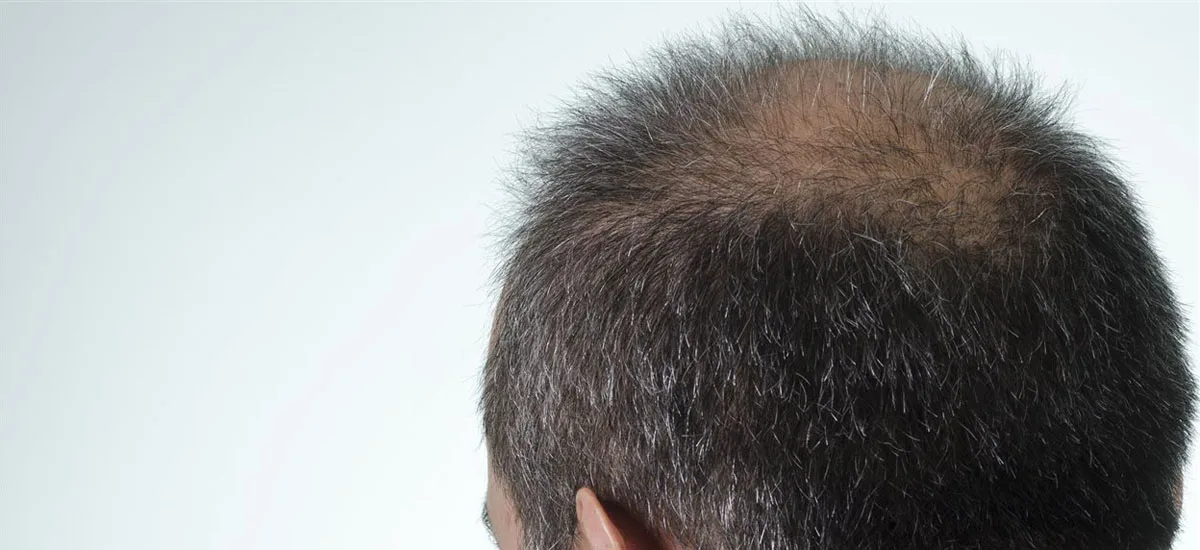
Common baldness. Under the influence of androgens the follicle miniaturises with each cycle: the hair grows back finer and shorter, then stops growing back at all. It follows a recognisable pattern, temples then crown, described by the Norwood scale. The hair at the back and sides is spared.
Medical treatment
Oral finasteride slows the miniaturisation. Minoxidil, applied to the scalp or taken orally at low dose, extends the growth phase. Both work for as long as they are taken, and stop working when they are stopped.
Where a transplant fits
This is the reference indication. Hair from the back of the head keeps its resistance to androgens once moved: that is the whole principle of the procedure.
Female pattern hair lossTransplant is indicated
The same mechanism with a different pattern: the parting widens, density falls across the top of the scalp, and the frontal hairline usually stays in place. It often becomes apparent at the menopause.
Medical treatment
Topical minoxidil remains first-line. Low-dose oral minoxidil is used off-label, with an international consensus published in 2025. Hormonal and iron studies are essential before concluding anything.
Where a transplant fits
Possible, but selection is stricter than in men: the donor area is often affected too, which limits the capital available.
Telogen effluviumA transplant is not the answer
Sudden diffuse shedding, two to four months after an event: childbirth, high fever, surgery, severe dieting, psychological shock, stopping a contraceptive. The hairs shift into the resting phase together and fall together.
Medical treatment
There is usually nothing to treat on the scalp. The cause is sought and corrected: iron, thyroid, deficiencies, a drug responsible. Regrowth is the rule within six to twelve months.
Where a transplant fits
None. Transplanting a telogen effluvium means operating on shedding that was going to stop by itself. It is the most common and most costly mistake for the patient.
Alopecia areataA transplant is not the answer
An autoimmune disease: the immune system attacks the follicle, which stops producing without being destroyed. It causes round, sharply bordered patches, sometimes total loss of scalp hair, sometimes of all body hair. It comes in flares, and regrows spontaneously in many limited forms.
Medical treatment
Topical or injected corticosteroids in mild forms. Since 2022 three JAK inhibitors have been approved for severe adult disease: baricitinib, ritlecitinib, deuruxolitinib. It is the most important change of the decade in this condition.
Where a transplant fits
Contraindicated. The follicle is not dead, it is being blocked: there is nothing to replace. And a transplant placed on active disease can trigger a fresh flare.
Frontal fibrosing alopeciaUnder strict conditions
A scarring alopecia that pushes the frontal hairline back in an even band, often with loss of the eyebrows. It mainly affects women after the menopause. The follicle is destroyed and replaced by fibrous tissue: the loss is permanent.
Medical treatment
The aim is not regrowth but stopping progression: 5-alpha-reductase inhibitors, topical corticosteroids, hydroxychloroquine depending on the case. Treatment is judged over years.
Where a transplant fits
Only worth considering once the disease has been silent for a long time. Published series cover few patients, with a mean stability of over a year before surgery and poorer results than in common baldness. A transplant placed on still-active disease can reactivate it.
Lichen planopilarisUnder strict conditions
The disease of which frontal fibrosing alopecia is one particular form. It causes irregular patches, often on the crown, with redness around the hair openings, scale collars, and itching or burning.
Medical treatment
Topical and injected corticosteroids, sometimes systemic treatment. The inflammation must be extinguished before anything else.
Where a transplant fits
The same reservations as for frontal fibrosing alopecia, and the same requirement: the disease must have been silent for a long time, confirmed on examination and trichoscopy.
Central centrifugal cicatricial alopeciaUnder strict conditions
It starts at the crown and spreads outwards in a circle. It mainly affects women of African descent. Tight styling, relaxers and heat are recognised aggravating factors on what appears to be a partly genetic background.
Medical treatment
Stopping damaging practices, topical or injected corticosteroids, sometimes antibiotics for their anti-inflammatory effect. The goal is to extinguish inflammation, not to regrow what is lost.
Where a transplant fits
Possible at end stage, when biopsy no longer shows inflammation. The literature recommends a test session of a few grafts, judged at three to six months, before any full procedure.
Folliculitis decalvansUnder strict conditions
A scarring alopecia of infectious and inflammatory origin, with pustules, crusts, and hairs emerging in tufts from a single opening. It comes in flares and leaves permanently bald areas.
Medical treatment
Systemic antibiotics in prolonged courses, topical antiseptics, corticosteroids as an adjunct. Relapses are common.
Where a transplant fits
Only after long, documented remission. Operating during a flare risks graft failure and extension of the disease.
Dissecting cellulitis of the scalpUnder strict conditions
Deep nodules and sinus tracts on the crown and back of the head, which discharge and leave raised scars. It is often associated with severe acne and hidradenitis suppurativa.
Medical treatment
Oral isotretinoin, antibiotics, corticosteroid injections. Some cases call for biologic therapy.
Where a transplant fits
Only worth considering on disease quiet for years, and on a scalp that has become supple again. It is a rare and delicate situation.
Traction alopeciaTransplant is indicated
Caused by repeated pulling: tight braids, extensions, pulled-back buns, weaves. It starts at the temples and along the hairline, where the pull is strongest. Reversible early on, it becomes scarring if the pulling continues for years.
Medical treatment
The only treatment that matters is stopping the traction. Minoxidil can help while the loss is still reversible. Past the scarring stage, no drug brings the follicle back.
Where a transplant fits
A good indication at the scarring stage, on one condition: that the practice responsible has stopped. Otherwise the grafts undergo the same pulling and are lost in turn.
TrichotillomaniaA transplant is not the answer
A behavioural disorder: the patient pulls out their own hair, often without being fully aware of it. The patches are irregular and oddly shaped, with hairs broken at different lengths, which distinguishes it from alopecia areata.
Medical treatment
Management is psychological and psychiatric. Behavioural therapies, habit reversal in particular, have proven themselves. The dermatologist confirms the diagnosis and rules out the rest.
Where a transplant fits
Contraindicated while the disorder is active. The grafts would be pulled out like the rest. A transplant is only discussed after lasting remission, and the subject belongs to the psychiatrist first.
Tinea capitisA transplant is not the answer
A fungal infection, common in children and contagious. It causes scaly patches with hair broken short, sometimes an inflammatory weeping mass called a kerion.
Medical treatment
An oral antifungal is essential; topical treatment alone is never enough. Mycological sampling guides the choice and duration. Close contacts must be examined.
Where a transplant fits
Not applicable in forms treated in time, where the hair grows back. A neglected inflammatory tinea can leave a permanent scar, which then falls to restorative surgery.
Acquired scarring alopeciaTransplant is indicated
Burns, road accidents, bites, surgical or radiotherapy sequelae. The follicle has been destroyed mechanically or thermally. The area is fibrous, less well supplied with blood, sometimes contracted.
Medical treatment
There is no medical treatment for an established scar. The physician's role is to wait for maturation, which often takes a year, and to judge suppleness and blood supply.
Where a transplant fits
A good indication, and one of the most rewarding. Density achieved remains below that of healthy scalp, because the skin feeds the grafts less well. Two sessions are often preferred.
Repair after a transplant done elsewhereTransplant is indicated
A hairline set too low or too straight, grafts placed at the wrong angle, a pluggy look, a donor area exhausted by excessive harvesting. This is not a disease, it is a surgical sequela.
Medical treatment
Nothing to treat medically, other than the ongoing loss elsewhere, which must be slowed so as not to be forever chasing it.
Where a transplant fits
A frequent indication at the clinic, and the most demanding. Badly angled grafts often have to be removed before new ones are placed, with a donor area already depleted. The result depends on what is left, not on what one would wish for.
The other side
What medical treatment can do
A drug does not replace a destroyed follicle. It acts on the one still living, and that is already a great deal: slowing loss in progress is often worth more than adding hair to a scalp that keeps thinning.
In androgenetic alopecia
Finasteride, one milligram daily, reduces the conversion of testosterone to dihydrotestosterone and slows miniaturisation. Its sexual side effects, uncommon but real, must be stated before prescription and not discovered afterwards. It is contraindicated in women of childbearing age.
Minoxidil extends the growth phase. Applied to the scalp it is the only treatment approved in women. Taken orally at low dose, between 0.625 and 5 mg daily, it is used off-label under an international expert consensus published in 2025. Its most frequent side effects are excess body hair, transient shedding at the start of treatment, and mild swelling.
Dutasteride is used in selected cases, off-label in this indication.
In alopecia areata
Topical and injected corticosteroids remain the first resort in limited forms. Severe forms changed horizon in 2022 with the arrival of JAK inhibitors: baricitinib approved in 2022, ritlecitinib in 2023, deuruxolitinib in 2024. These are prescribed and monitored in specialist care.
In scarring alopecias
The aim is to extinguish inflammation, never to regrow what is destroyed. Corticosteroids, antimalarials, antibiotics for their anti-inflammatory effect, 5-alpha-reductase inhibitors depending on the disease. Success is judged on progression stopping.
What is not proven
PRP is used as an adjunct in androgenetic alopecia, with results that vary by protocol and evidence that remains uneven; at the clinic, it is used mainly after a transplant, for healing. Exosomes, promoted for some years now, rest on no solid human data to date, and are sold at prices unrelated to what is known about them. We do not offer them.
What to expect from the consultation
A diagnosis before a proposal
The consultation begins with an examination, not a quote. History, scalp examination under trichoscopy, assessment of the donor area, and where needed blood tests or a biopsy. That is what makes it possible to say whether this is common baldness, an effluvium that will stop, or an inflammatory disease that forbids surgery.
Three answers are possible at the end, and all three are answers: a procedure, medical treatment without surgery, or referral to another practitioner when the subject is not hair.
A physician who never says no is not an accommodating physician; he is one whose opinion is worth nothing.
Can hair loss cause depression?
Does Dr Seffen turn patients down?
Is medical treatment needed before a transplant?
Can a transplant be done on a scalp disease?
What is trichoscopy?
Seek the advice of a specialist
A diagnosis prepared personally by Dr Seffen from your photographs, before any question of surgery.