

In practice
Eyebrow transplant in Tunisia
Densifying, redesigning and restoring relief to the curve of the eyebrows, hair by hair.
The gaze
The eyebrow frames the eyes, and the eyes carry the face
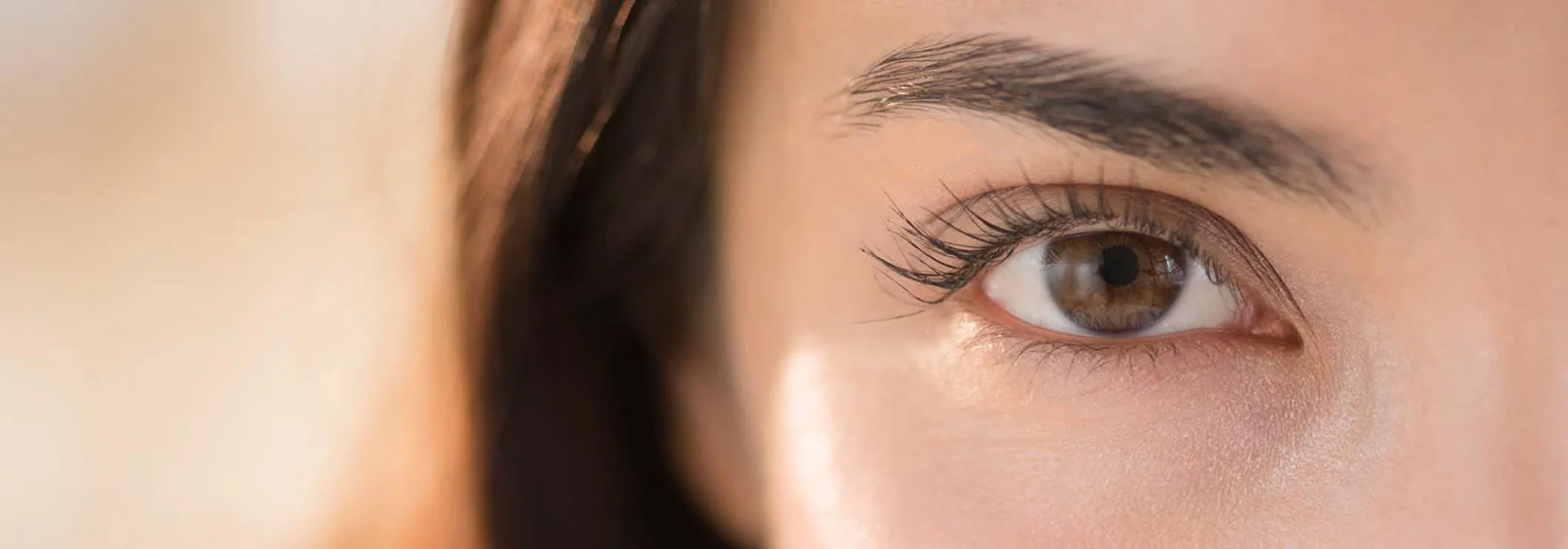
A thinning eyebrow changes a face far more than people expect. It flattens expression, weighs down the eyelid and makes the gaze look tired. Unlike baldness, losing your eyebrows is not an expected process: it draws attention, and it is often hard to live with.
An eyebrow transplant is micro-surgery. We do not lay a shape onto a brow ridge: we rebuild an eyebrow hair by hair, following the original direction, angle and curvature of each one. Every single implantation is a separate decision.
Causes
Why eyebrows thin out
The consultation always begins by identifying the cause: some require medical treatment before a transplant can be considered, others call for a period of stabilisation first.
Repeated plucking
The most common cause in women. Years of tweezing or waxing eventually destroy part of the follicles for good: the hair no longer grows back, even once plucking stops.
Alopecia areata and autoimmune disease
Alopecia areata can settle on the eyebrows and cause patchy loss. A transplant is only considered after a sufficient period of stability, since the condition can also affect transplanted hairs.
Thyroid disorders
Hypothyroidism classically thins the outer third of the eyebrow. Treating the thyroid always comes first, as density may recover on its own.
Burns, accidents and scars
A scar interrupts the eyebrow and leaves a permanently bare area. A transplant restores continuity; feasibility depends on how supple and well vascularised the scar is.
Chemotherapy and radiotherapy
Eyebrows usually grow back after chemotherapy. When regrowth remains incomplete beyond a year, or after localised irradiation, a transplant takes over.
Tattooing, microblading and age
A poorly performed tattoo or microblading can damage the follicles. Finally, eyebrows naturally thin with age, particularly in their outer part.
For women
Restoring a line, not drawing a shape
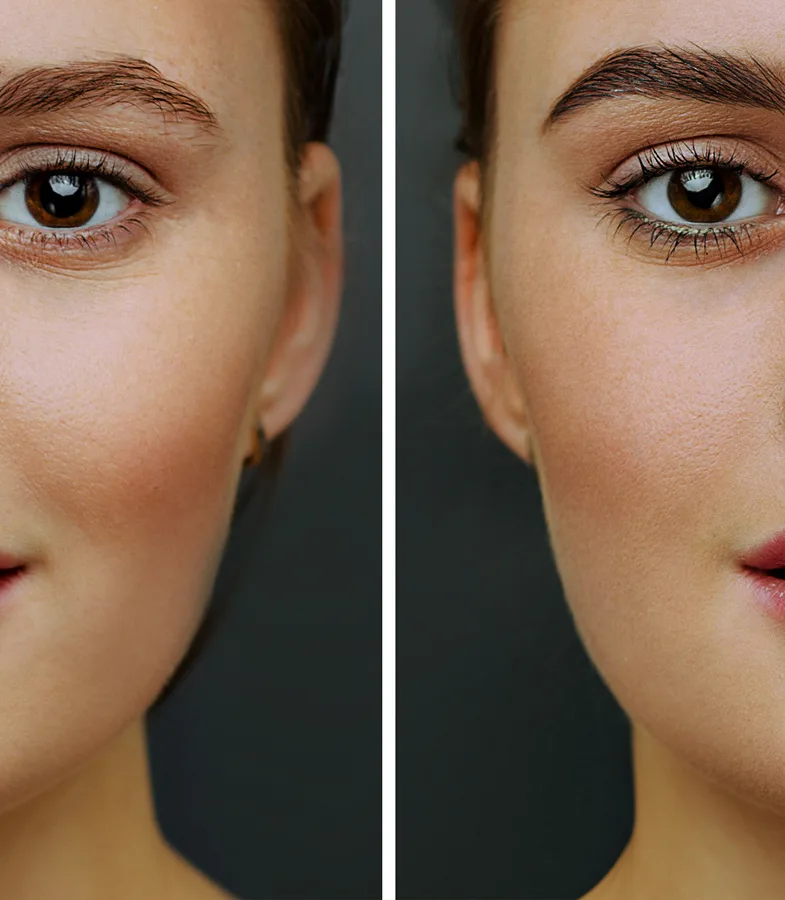
Requests from women most often concern eyebrows exhausted by plucking: a tail that has vanished, a sparse head, an asymmetry that has settled in. The aim is not to reproduce a fashionable shape, which will date, but to restore a line consistent with the structure of your face and with the hairs you still have.
The design is drawn on your skin before the procedure and approved by you in front of a mirror. Nothing is implanted until the shape suits you.
The result then grows like a real eyebrow: you can trim it, brush it, make it up or leave it be. Unlike permanent make-up, it does not fade and does not change colour.
For men
Adding density without feminising
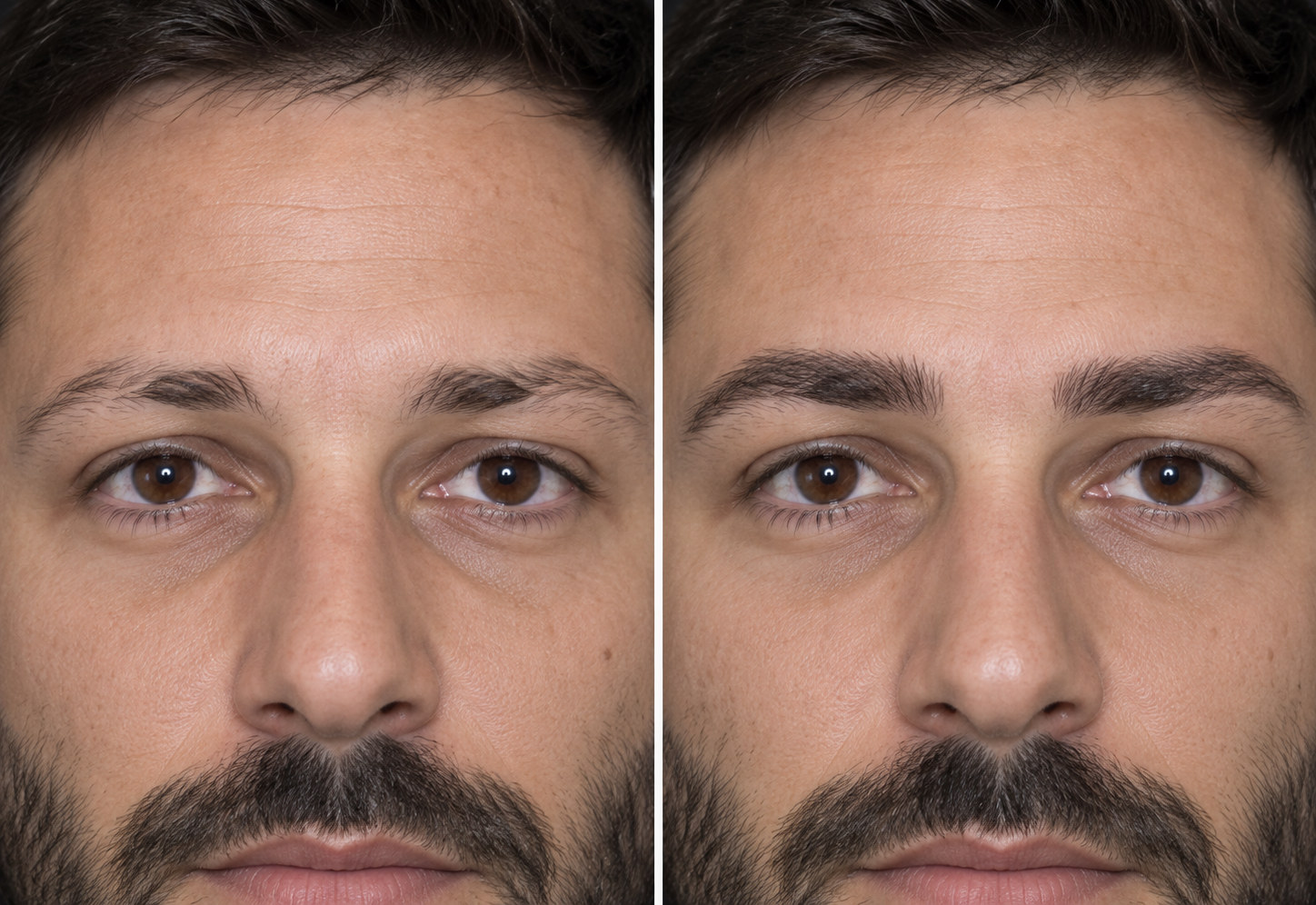
In men, the request rarely comes from plucking: it is more often a naturally sparse eyebrow, a scar, the aftermath of a burn, or thinning with age.
The male eyebrow is flatter, wider, less arched, and its lower edge sits closer to the orbit. A transplant that ignores these differences produces a feminised gaze that reads as artificial at once. The male outline is therefore deliberately straighter, with density spread along the whole length rather than concentrated on the arch.
Eyebrows are an essential component of the appearance and expression of the face. In many respects, eyebrows are at least as important to facial appearance as the hair on the head, since they occupy a central position and frame the eyes. Unlike hair loss on the head, the loss of eyebrows is not a natural process, which is why the lack or absence of eyebrows is often difficult to live with, not to mention that it draws attention.
Eyebrows may be missing for a number of reasons, including thyroid disease and other systemic diseases, alopecia areata, burns, tattoos, infections, repeated plucking, congenital absence of eyebrows, as well as the tendency of eyebrows to thin or miniaturise over time.
Eyebrow implantation is a micro-grafting technique that fills a lack of hair in the brow area. This procedure aims to densify the eyebrow, redesign it and restore relief to its curve. Because eyebrows have unique attributes, the eyebrow transplant differs from a hair transplant in several important respects.
Characteristics of eyebrows
The direction of eyebrow hairs changes noticeably at different points along the brow. In the region where the eyebrow is close to the nose, the hairs point upwards. Hairs in the upper part of the eyebrow point outwards and downwards. Hairs in the lower part grow outwards and upwards. This interlocking pattern causes the hairs in the middle of the eyebrow to converge, forming a natural ridge running horizontally along each brow.
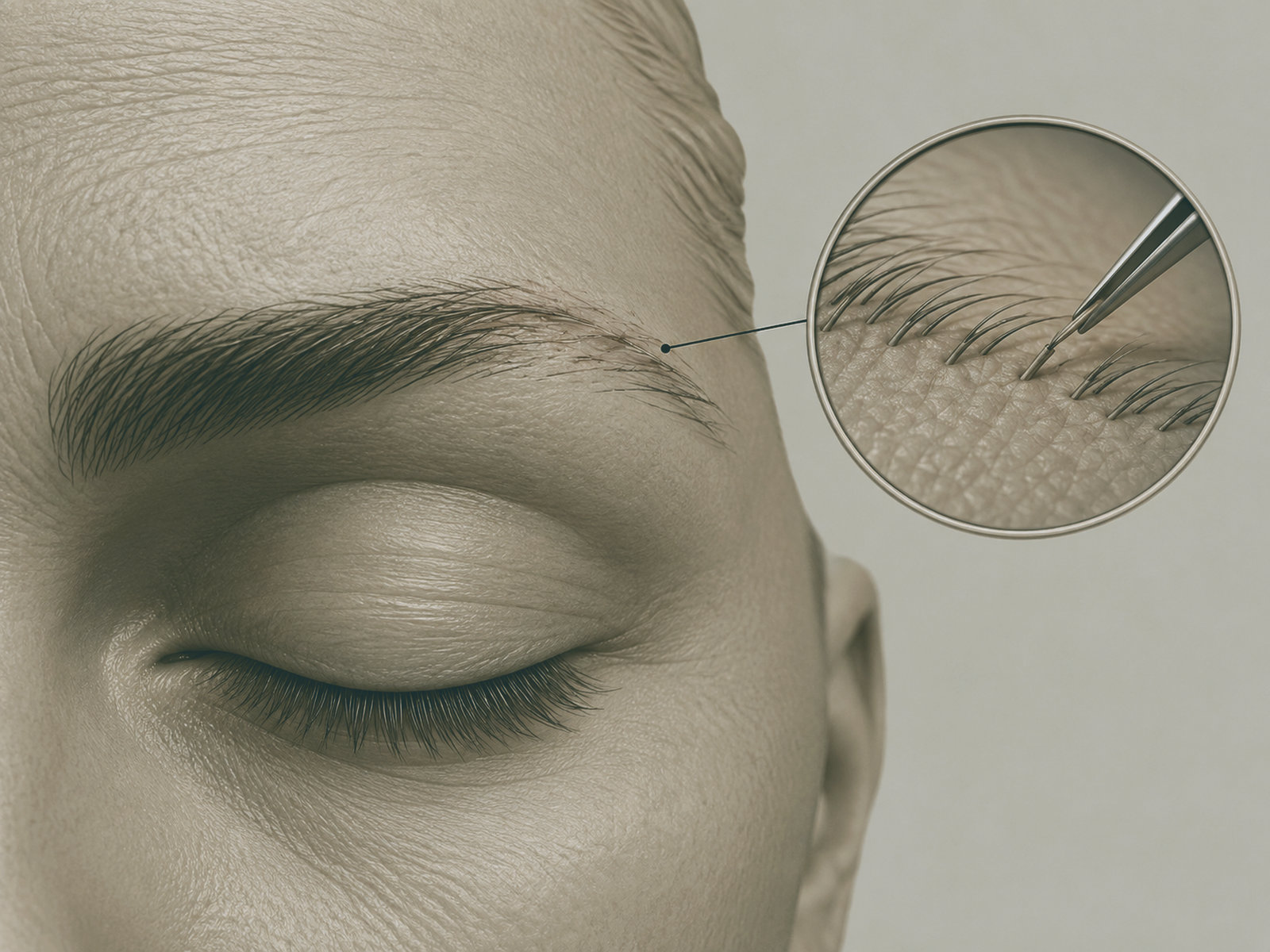
The second distinctive characteristic of eyebrow hairs is that they emerge from the follicles at a very acute angle, so as to run along the surface of the skin as they grow. By contrast, the emergence angle of scalp hair goes up to 45 degrees.
The third important characteristic is that eyebrow hairs grow singly, and not in groups of 1 to 4 hairs like the follicular units of the scalp.
The last distinctive element of eyebrows is their very short growth cycle: eyebrow hairs grow (in the anagen phase) for only about 4 months before entering a resting phase (telogen phase) and then shedding. By comparison, scalp hair has a growth phase that can last 3 to 7 years.
The eyebrow transplant technique
The most important aspect of the eyebrow transplant is to follow the natural direction of the hairs meticulously. This must anticipate the acute growth angle of the hairs in order to reproduce the original appearance of the eyebrows and the converging direction of the hairs along the brow. More importantly, the incisions intended to receive the eyebrow hairs must be made with a very fine instrument that slides beneath the surface of the skin, so that the hairs lie flat above the skin surface as they grow.
Another important aspect is that only individual hair follicles can be used. Because the scalp is made up of follicular units containing 1 to 4 hairs, these units may need to be divided into individual grafts under a microscope. Technically speaking, the eyebrow transplant is considered a refined form of micro-grafting rather than a transplant.
The individual placement of the hairs and the creation of the implantation sites in the eyebrows require considerable mastery and a great deal of experience from the surgeon. Moreover, when the patient's hair is wavy or curly, it is important to rotate the hair so that the curvature of the shaft follows the natural curve of the eyebrow.
Unlike a hair transplant, which consists in harvesting hairs and reimplanting them in the same scalp, the hairs chosen to be reimplanted in the eyebrows do not come from the eyebrows. The characteristics of the harvested hairs may be slightly different in terms of growth rate and appearance. Transplanted hairs keep most of their donor characteristics, their rate of growth included: they go on growing like scalp hair and need regular trimming, which is why the finest hairs are chosen. The appearance of the eyebrows settles over a period of about one year. During this period, the eyebrows can be trimmed and shaped as desired.
Result
Before / after
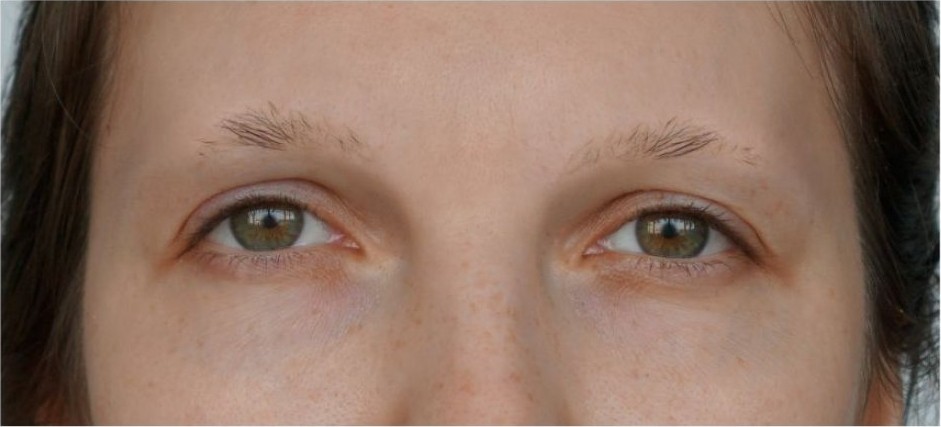
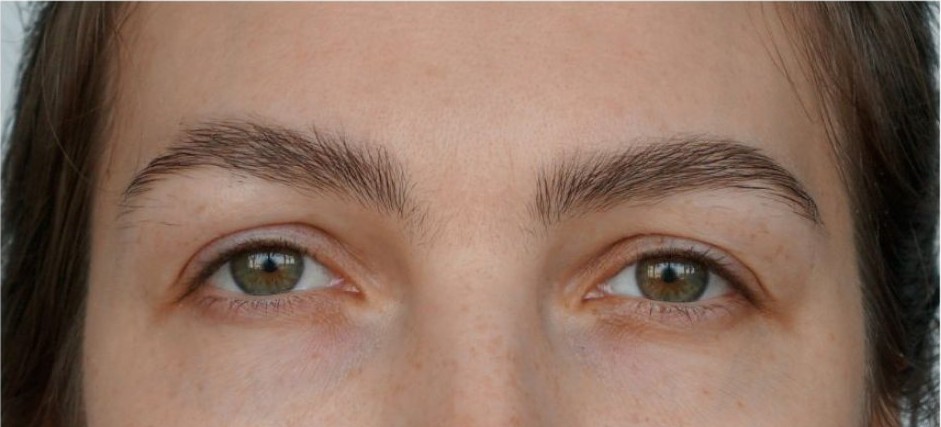
In practice
How the day unfolds
The procedure is performed as a day case, under local anaesthesia, and you go home the same day. Hairs are harvested from the back of the head, where they are finest, then separated one by one under a microscope before being implanted.
You stay awake and can talk, listen to music or watch a film. The only unpleasant sensation is the anaesthetic injections, right at the start.
Small crusts form over the grafted area and fall off within about ten days. Slight swelling of the eyelids is possible for the first two or three days.
- Duration
- 2 to 4 hours
- Anaesthesia
- Local
- Hospital stay
- Day case
- Grafts
- 150 to 400 per eyebrow
- Crusts
- 10 to 15 days
- Back to work
- 2 to 5 days
- Final result
- 12 months
Patience
What happens, month by month
Transplanted hairs fall out before they grow back. This is normal and expected, and it is the stage that worries patients most when they have not been warned.
- Day 0
The procedure
The eyebrows look full straight away: those are the grafted hairs, still in place. Small crusts over the area.
- Days 10 – 15
Crusts fall off
The crusts come away on their own and the area becomes clear again.
- Weeks 3 – 8
Grafted hairs shed
Almost all the implanted hairs fall out. The eyebrow returns to how it looked before, sometimes slightly sparser. The follicle itself is firmly in place under the skin: this is a required stage, not a failure.
- Months 3 – 4
First regrowth
The first permanent hairs appear, still fine and sparse.
- Month 6
Halfway there
About half the hairs have grown back. The shape of the eyebrow reads again.
- Month 12
Final result
Density and texture have settled. The hairs keep their donor characteristics: they grow like scalp hair, so regular trimming is needed.
Comparison
Transplant, microblading or tattoo?
Eyebrow transplant
Your own hairs, genuinely growing and able to be styled. Lasting, with no colour retouching; the only upkeep is regular trimming. In exchange: a surgical procedure, and twelve months before the final result.
Microblading and permanent make-up
Strokes of pigment deposited in the skin. Immediate result, but in two dimensions: no relief, no hair. The pigment fades within 12 to 18 months and often turns reddish or blue-grey, requiring touch-ups for life.
The two are not necessarily mutually exclusive: existing permanent make-up does not rule out a transplant, and some patients keep a light pigmentation between the grafted hairs while density builds up. Recent microblading, however, requires waiting for complete healing before implanting.
Frequently asked
What patients ask us
Does it hurt?
The procedure is performed under local anaesthesia: you feel nothing during harvesting or implantation. Only the anaesthetic injections, right at the start, are unpleasant. Recovery is not very painful and a simple painkiller is usually enough.
Will the grafted hairs grow like scalp hair?
Yes. They come from the scalp and keep their growth rate, so they need trimming roughly once a month. That does not change with time: trimming remains part of the routine, and it is the price of having real hairs rather than pigment.
Will there be scars?
Harvesting is done by FUE, with a punch under one millimetre: it leaves no linear scar, only tiny dot scars that are usually hidden once the hair has grown back. On the eyebrow, the incisions are very fine and normally heal without a visible mark.
Can you transplant onto a scar?
Often yes, but it depends on the scar: its age, suppleness and blood supply determine graft survival. A fibrous, poorly vascularised scar gives a lower regrowth rate, and two sessions are sometimes needed. Only an examination can settle it.
How long before going back to work?
Two to five days. Crusts remain visible for about ten days and slight eyelid swelling is possible in the first few days: that is mostly what determines when you will feel comfortable in public.
Is a second session needed?
Not in most cases. Additional densification can be offered after twelve months if you would like more thickness, or where the first procedure was performed on a scar.
Have your case assessed
Send your photographs and receive a preliminary assessment and an estimated quote, prepared by Dr Seffen himself. Free, and without obligation.