

Understanding
Hair loss
Understanding androgenetic alopecia in men and women, and knowing when a transplant is a treatment option.
Hair loss is the result of genetic programming in the vast majority of cases, which means that people suffering from baldness were always predestined for it. This hair loss, referred to as androgenetic alopecia (AGA), can appear at different ages, from 18 years old in the earliest forms. Once it has started, this hair loss is inevitable and its progression pattern is unfortunately unpredictable. Nevertheless, looking for miniaturised hairs, using trichoscopy during the consultation, makes it possible to determine which areas are likely to experience hair loss in the future.
Classification
Two categories of alopecia
Non-scarring alopecia
A hair transplant is an excellent treatment option for androgenetic alopecia. It is not one for telogen effluvium, which stops by itself, nor for alopecia areata and active trichotillomania, which are contraindications.
- Androgenetic alopecia (AGA)
- Trichotillomania
- Telogen effluvium
- Alopecia areata
Scarring alopecia
A transplant is not an option while the disease is active. On a stable scar, after a burn or an accident, or on a disease that has been quiet for a long time, a restorative transplant can be discussed.
- Traction alopecia: straightening, African braids, perms, tight ponytails…
- Radiotherapy
- Systemic diseases (lupus…)
- Burns, accidents, fungal infections, lichen planus…
Baldness in men
- Androgenetic alopecia is the major cause of alopecia in men. 30% of men lose their hair at 30, 50% at 50, 60% at 60 and so on.
- AGA is assessed using the Norwood classification, which determines the stage your baldness has reached. This baldness generally starts with a deepening of the temporal recessions and a receding frontal hairline, before affecting the vertex; most of the time it widens until only a simple "crown" of hair remains.
- Men generally start to worry when they realise that their hair is thinning and losing volume. During a consultation with a physician who specialises in hair restoration, this "miniaturisation" of the hair in certain areas can be identified and a treatment plan established accordingly.

Baldness in women
- It is estimated that more than 50% of women experience visible hair loss during their lifetime. As the most common hair loss is caused by androgens, this is also referred to as female androgenetic alopecia.
- All women can be affected by hair loss. However, there is a clearly increased risk among women over 40, those who have recently given birth, those whose hairstyle exerts strong tension on the hair (ponytails, braids…) and those who use aggressive chemical products on their hair (colouring, cosmetics…).
- Female androgenetic alopecia is often characterised by the miniaturisation of hair along the top of the head (central parting). This hair loss tends to accelerate with the drop in oestrogen levels at menopause.
Norwood scale
The 7 stages of hair loss progression
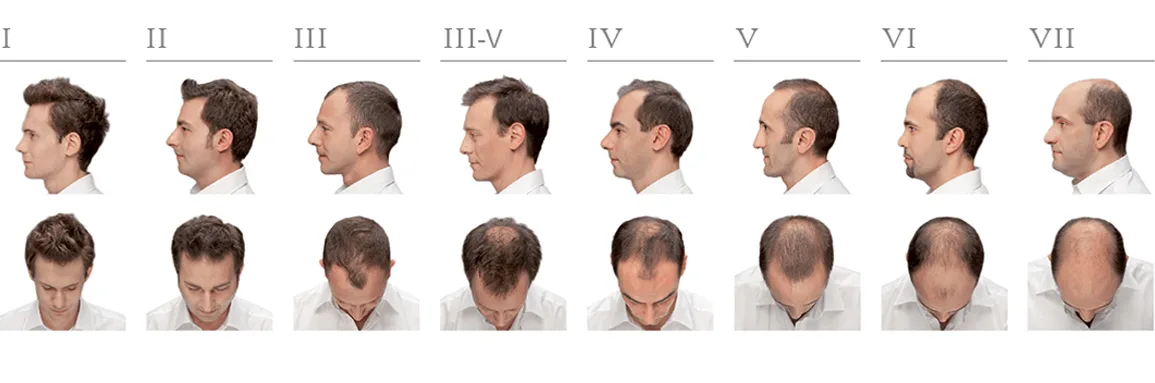
Stage 1
No notable hair loss or recession of the frontal hairline.
Stage 2
Slight recession of the hairline at the temples.
Stage 3
First notable signs of baldness appear. Significant recession of the hairline at the temples. These areas are entirely bald or sparse. This stage may otherwise be marked by significant hair loss at the vertex.
Stage 4
The recession of the hairline is more marked than at stage 2 and the vertex is sparse or bald. The two areas of hair loss are separated by a band of hair connecting the remaining hair on the sides of the head.
Stage 5
The two areas of hair loss are more pronounced than at stage 4. They remain separate, but the band of hair connecting the sides of the head is thinning.
Stage 6
The bald temporal areas and the bald vertex merge into one and the band of hair at the top is sparse or has disappeared.
Stage 7
Only a band of hair remains on each side of the head.
Have your case assessed
Send your photographs and receive a preliminary assessment and an estimated quote, prepared by Dr Seffen himself. Free, and without obligation.