

September 18, 2026By Dr Fares Seffen
Hair Transplantation for Trans Women: The Art of Creating a Natural Feminine Hairline
How can hair transplantation feminise a hairline? Hairline shape, temporal recession, graft selection, angles and density: the surgical principles behind a natural result.
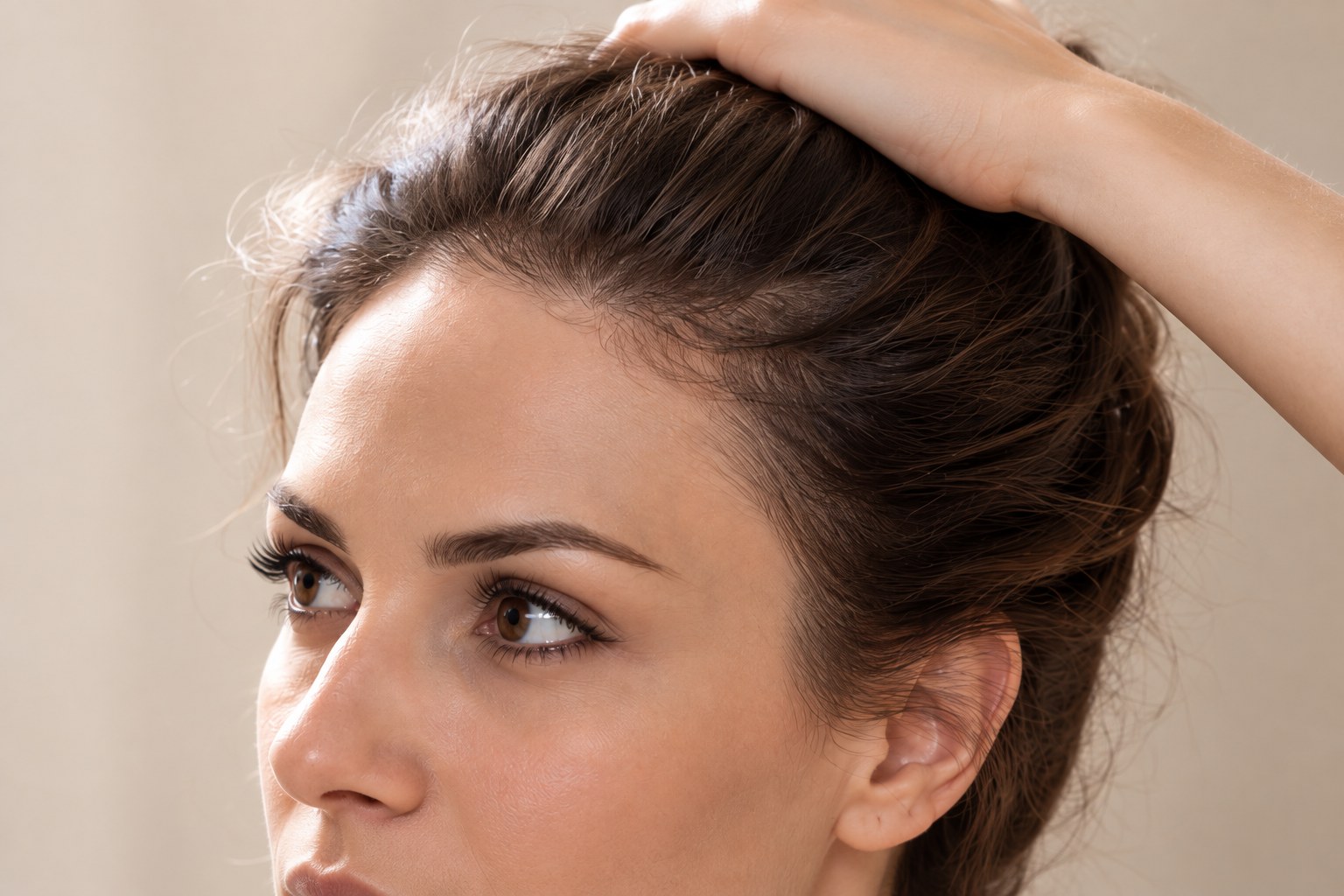
For a transgender woman, hair transplantation should not simply be viewed as a procedure to lower the hairline or fill the temporal recessions. Its purpose can be considerably more sophisticated: to redesign the architecture of the upper face through a softer, more feminine hairline while preserving a result that looks natural both immediately and decades later. The forehead and hairline play an important role in the perception of the upper third of the face, and their relationship has become an established consideration within facial gender-affirming surgery.1
When a trans woman presents with a traditionally masculine hairline or previous androgenetic hair loss, the challenge is therefore not simply to "put hair back". It is to create a new hairline that belongs naturally to her face while respecting hair characteristics and the finite resources of the donor area.
A feminine hairline is not a male hairline placed lower
This distinction is fundamental. There is considerable natural variation in both male and female hairlines, and no universal feminine template should be reproduced identically from one patient to another. Anatomical studies nevertheless identify tendencies: masculine hairlines more frequently display pronounced frontotemporal recession and an M-shaped pattern, whereas feminine hairlines tend to preserve a softer transition around the frontotemporal region. Natural female hairlines can, however, be round, rectangular, triangular or even mildly M-shaped. Feminisation must never become standardisation.2, 3
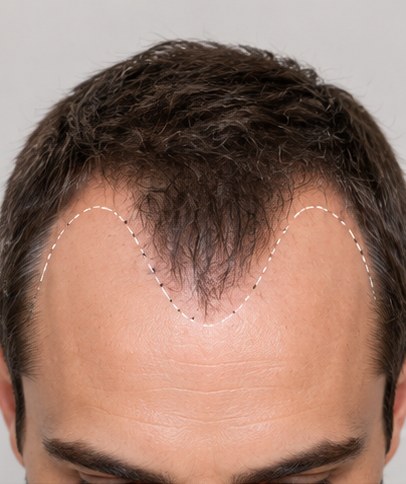
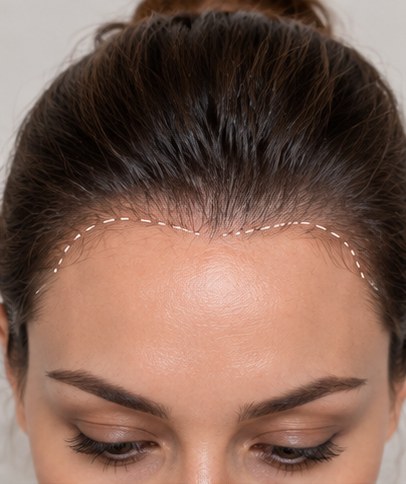
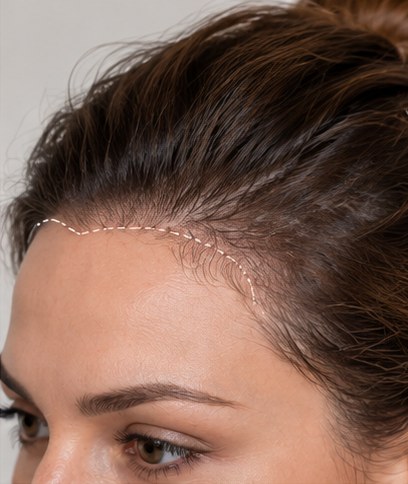
Illustrative diagrams, generated; they do not show patients of the clinic.
A successful feminine hairline is therefore much more than a smooth semicircular line drawn across the forehead. An excessively low, perfectly rounded and symmetrical hairline may appear just as unnatural as an overly masculine one. The design must be created for the individual face.
Feminising the frontotemporal recessions
In many transgender women, the most recognisable feature of a previously masculine hairline is frontotemporal recession, which years of androgen exposure or androgenetic alopecia deepen into a pronounced M shape. Correcting this area may contribute more to feminisation than simply lowering the central point. A recent surgical publication on hairline feminisation, using flaps and forehead advancement rather than transplantation, highlights the importance of correcting temporal recession rather than concentrating on central advancement: the morphological point holds for transplantation, even though the technique differs.4 Gender-affirming hair transplantation techniques are described elsewhere.5
The surgical design therefore aims at a softer relationship between the central frontal hairline, the frontotemporal recessions, the lateral hairline and the temporal points. This transition must remain anatomical: excessive closure of the recessions produces an unnatural contour and consumes a substantial number of donor follicles.
The correct hairline height cannot be defined by a number
It is tempting to define an "ideal feminine hairline" at a fixed distance above the eyebrows. This is too simplistic. Anatomical studies provide average measurements of female forehead dimensions, but they also demonstrate significant variation between individuals and populations.2, 3, 6 The appropriate position depends on facial height, the proportions between the upper, middle and lower thirds, forehead shape, eyebrow position, age, the existing hairline and the available donor supply. A hairline must belong to the face; it should never be imposed upon it. In selected patients, subtle correction of the temporal recessions produces considerably more feminisation than aggressive lowering of the entire frontal hairline.
Graft selection is as important as hairline design
A refined hairline depends not only on where the follicles are placed but on which follicular units are selected for each part of the reconstruction: grafts are not interchangeable. Along the leading edge, single-hair follicular units are essential; the finest available hairs create a gradual transition from bare forehead skin to the greater density behind the hairline. The literature on female hairline correction describes the classification of donor follicles by calibre and number of hairs, from very fine single-hair units through thicker singles to multi-hair units.7
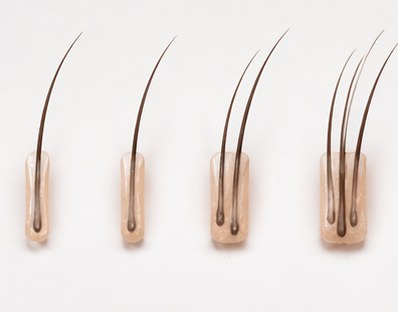
For particularly refined work, finer-calibre follicles from suitable lower occipital or post-auricular regions may be reserved for the leading edge. A 2026 study of refined female hairline transplantation describes harvesting from occipital and post-auricular regions and progressively varying density and hair characteristics across the recipient area.8 Two- and multi-hair units then contribute density behind this transition zone. The principle is straightforward: density should be built behind the hairline rather than beginning abruptly at its edge.
Thick or multi-hair grafts placed directly along the frontal border are one of the classic features of an immediately recognisable transplant. Natural hairlines display lower apparent density and greater delicacy at their leading edge; two- or three-hair units on that border create a dark, abrupt appearance. For a feminine hairline this detail matters even more: the frontal edge should withstand close examination when the hair is tied back or styled away from the forehead.
A natural hairline is not a drawn line
Natural hairlines are not geometrically perfect: examined closely, they contain subtle variations, micro-irregularities and gradual changes in density. A perfectly repetitive row of grafts creates an artificial pattern, while excessive irregularity produces a poorly defined contour. The objective is organised irregularity, subtle enough to reproduce nature while preserving the architecture of the design: naturality depends not only on the position of the hairline but on reproducing its visual characteristics through appropriate follicular-unit placement.11
Direction and angulation
A well-selected graft placed at an incorrect angle remains visible. In the frontal region, follicles must emerge from the scalp in a direction consistent with the surrounding hair and the intended natural flow. That direction changes gradually from the centre toward the temples, where angulation becomes particularly demanding: hair placed too vertically in the temporal region cannot be styled naturally. A feminine hairline must therefore be designed in three dimensions, with position, direction and exit angle inseparable. Correct angulation is also what allows the patient to wear her hair away from the face or tied back without revealing a transplanted border.
Temporal points require particular precision
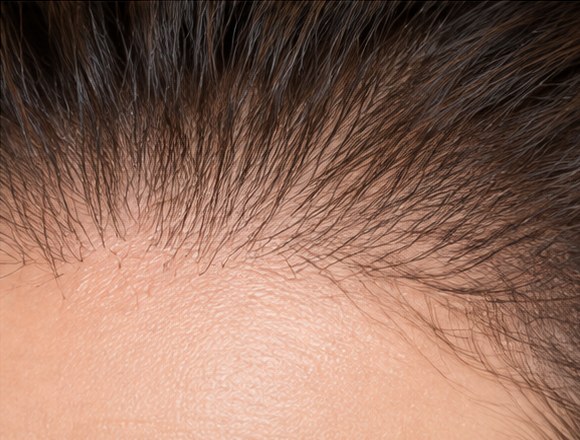
Temporal points strongly influence the frame of the face. When they have receded substantially, carefully selected restoration may complement the feminisation of the frontal hairline. This is, however, one of the most technically demanding areas of hair transplantation: natural temporal hairs are finer and emerge at very acute angles to the skin, and incorrect graft selection or angulation becomes highly visible. Temporal reconstruction should therefore never be automatic; it is considered according to the patient's anatomy, donor quality and overall aesthetic objectives.
Hormones, androgenetic alopecia and the donor area
Some trans women have already experienced years of androgen-related hair miniaturisation before beginning their transition, so frontotemporal recession or more advanced androgenetic alopecia may already be present. Feminising hormone therapy can influence scalp hair: a 2023 systematic review found that estradiol and/or antiandrogen therapy may improve aspects of androgenetic alopecia in transgender women, although responses vary and the evidence remains limited.9 A more recent observational study suggests that estrogen therapy contributes to stability of the lateral hairline in some transfeminine patients; it cannot promise stabilisation for any given individual.10
This does not mean that deeply recessed areas will reconstruct themselves. Assessment therefore distinguishes three goals: stabilising ongoing miniaturisation, with the medical treatments that have proven themselves, optimising existing hair, and surgically restoring permanently depleted areas when transplantation is appropriate.
Hairline feminisation remains a transplantation procedure, and donor follicles are finite. A very low hairline combined with complete closure of extensive temporal recessions requires a large recipient surface and a substantial number of follicular units, which matters all the more in patients who also have thinning within the midscalp, the middle of the scalp, or the crown. The surgeon's objective is not to design the lowest possible hairline, but the most naturally feminising hairline that can be achieved sustainably within the patient's donor resources.
FUE and feminine hairline reconstruction
Follicular Unit Extraction allows individual follicular units to be harvested from the donor area, but extraction is only one component of the procedure. In sophisticated frontal reconstruction, the result depends at least as much on aesthetic planning, follicular-unit selection, graft preparation, recipient-site creation and control of direction and angulation as on the harvesting method itself. A technically successful transplant can still look artificial when the design is inappropriate; conversely, the most elegant drawing cannot produce a refined result if graft selection and angulation are poorly executed.
What to know before deciding
A feminising transplant is prepared like any FUE procedure, with its limits. Candidacy is assessed at the consultation: stability of the hair loss, donor reserve, current hormone therapy, realistic expectations. Some requests are declined, or postponed while a medical treatment takes effect. As for any female patient, the recipient area is not shaved; only a strip of the donor area is trimmed, and the hair above covers it. Recovery is that of an FUE: crusts for about ten days, a return to work after five to seven days, sport after two weeks, sometimes a transient swelling of the forehead or a temporary shedding of neighbouring hairs. The transplanted hairs shed and then regrow from the third month; the result is judged between the ninth and twelfth month, and the final review takes place at fifteen months. A second session can be planned from the outset when the strategy requires it. Precautions and the course of the day are detailed on the FUE hair transplant and hair transplants for women pages.
Feminisation must remain individual
Gender-affirming hair transplantation should never reproduce one universal model of femininity. Some women naturally have relatively high hairlines, some have central peaks, some retain small temporal recessions, others have a more rectangular frontal contour: studies of naturally occurring female hairlines demonstrate precisely this diversity.3 The objective is not to erase every feature according to a predetermined template, but to establish harmony between the forehead, the hairline and the rest of the face while respecting the patient's objectives and the biological limitations of her hair.
Conclusion
For a transgender woman, hair transplantation designed to feminise the frontal hairline is fundamentally a surgery of design. The result depends on a sequence of precise decisions: hairline position, management of the temporal recessions, frontotemporal contour, selection of the finest follicular units, gradual distribution of density, and accurate direction and angulation in each region. Success is measured neither by the number of grafts transplanted nor by the centimetres gained on the forehead, but by the fact that, once growth is complete, the hairline appears to belong naturally to the face and the transplant itself becomes imperceptible.
Frequently asked questions
Can a hair transplant feminise a trans woman's face?
It can contribute significantly to reshaping the frame of the upper third of the face when the existing hairline shows frontotemporal recessions, an M shape or recession linked to androgenetic alopecia. The effect depends on the initial anatomy and the donor area.1
Am I a candidate for a feminising hair transplant?
The decision follows an examination: stability of the hair loss, density and calibre of the donor area, current hormone therapy, expectations. Active hair loss is treated medically first; a hairline that is too low or too costly in grafts is redesigned, or declined. The consultation begins with that examination.
What is the difference between a male and a female hairline?
Does the head have to be shaved?
Not the recipient area, as for any female patient: the grafts are placed between the existing hairs. Only a strip of the donor area, at the back, is trimmed, and the hair above covers it.
Which grafts are used for a feminised hairline?
The finest single-hair follicular units are preferred along the leading edge, while units with more hairs progressively build density further back.7
What is recovery like, and when is the result visible?
Crusts for about ten days, a return to work after five to seven days, sport after two weeks. The transplanted hairs shed in the first weeks and regrow from the third month; the result is judged between the ninth and twelfth month, and follow-up by photographs continues until the final review at fifteen months.
Can hormone therapy regrow the temporal recessions?
Feminising hormone therapy may improve or stabilise some aspects of androgenetic alopecia in some patients, but it does not guarantee the rebuilding of areas whose follicles are already lost.9
Sources
- Capitán L, Simon D, Bailón C, et al. The Upper Third in Facial Gender Confirmation Surgery: Forehead and Hairline. J Craniofac Surg. 2019;30(5):1393-1398.
- Nusbaum BP, Fuentefria S. Naturally occurring female hairline patterns. Dermatol Surg. 2009;35(6):907-913.
- Sirinturk S, Bagheri H, Govsa F, Pinar Y, Ozer MA. Study of frontal hairline patterns for natural design and restoration. Surg Radiol Anat. 2017;39(6):679-684.
- Ives GC, Martin A, Munabi NCO, et al. Temporal rotation flaps for gender-affirming hairline feminization: taking the “M” shape out of masculine hairlines. J Plast Reconstr Aesthet Surg. 2025;102:404-411.
- Bared A, Epstein JS. Gender-Affirmation Hair Transplantation Techniques. Facial Plast Surg Clin North Am. 2023;31(3):375-380.
- Kurian K, Hao Y, Boczar D, et al. Systematic Review and Meta-analysis of Facial Anthropometric Variations Among Cisgender Females of Different Ethnicities: Implications for Feminizing Facial Gender Affirming Surgery. J Craniofac Surg. 2023;34(3):949-954.
- Wu W, et al. Enhancing Mid-Upper Facial Contours: Hairline Transplant Solutions for East Asian Women With High and Wide Foreheads. J Cosmet Dermatol. 2025;24(8):e70374.
- Tang S, Wu X. Natural-Looking Hairline Restoration with Refined Hair Transplantation Techniques to Improve Facial Aesthetic in East Asian Females. Aesthetic Plast Surg. 2026;50(11):4441-4449.
- Tang GT, Zwickl S, Sinclair R, Zajac JD, Cheung AS. Effect of gender-affirming hormone therapy on hair growth: a systematic review of the literature. Clin Exp Dermatol. 2023;48(10):1117-1127.
- Nguyen NH, Taylor JM, Huang KX, Lee JC. Estrogen hormone therapy stabilizes lateral hairline in transfeminine patients: implications for facial feminization surgery. J Plast Reconstr Aesthet Surg. 2025;101:246-251.
- Shapiro R. Principles and techniques used to create a natural hairline in surgical hair restoration. Facial Plast Surg Clin North Am. 2004;12(2):201-217.
Have your case assessed
Send your photographs and receive a preliminary assessment and an estimated quote, prepared by Dr Seffen himself. Free, and without obligation.