

June 30, 2019
How alopecia acts on hair follicles
What hair is made of, how follicles feed it, and how DHT shrinks them until growth stops. Why the back and sides of the head are spared.
According to the statistics, androgenetic alopecia in men affects around one third of Caucasians under 30, a figure that rises to around 80% of men over 70. Hair loss is less common in African Americans, and occurs later and more slowly in Asians.
Here is more detail about hair, about the follicles that grow it, and about the androgenetic alopecia that, conversely, makes them shrink.
How alopecia acts on hair follicles
About hair
Hairs are fine shafts made of a protein called keratin. They are anchored in a group of specialised cells called follicles, which supply oxygen and nutrients to the hair roots, or bulbs, and also lubricate the hair with an oily substance called sebum.
The human body is entirely covered with hair follicles, except for the palms of the hands, the soles of the feet and the lips. Most follicles are small, and the hairs they produce do not grow enough to emerge from the pores.
Among the areas where hair does emerge, and is visible above the level of the skin, are the underarms, the face, the genitals, the chest, the back and, abundantly, the head. The scalp contains around 100,000 hair follicles.
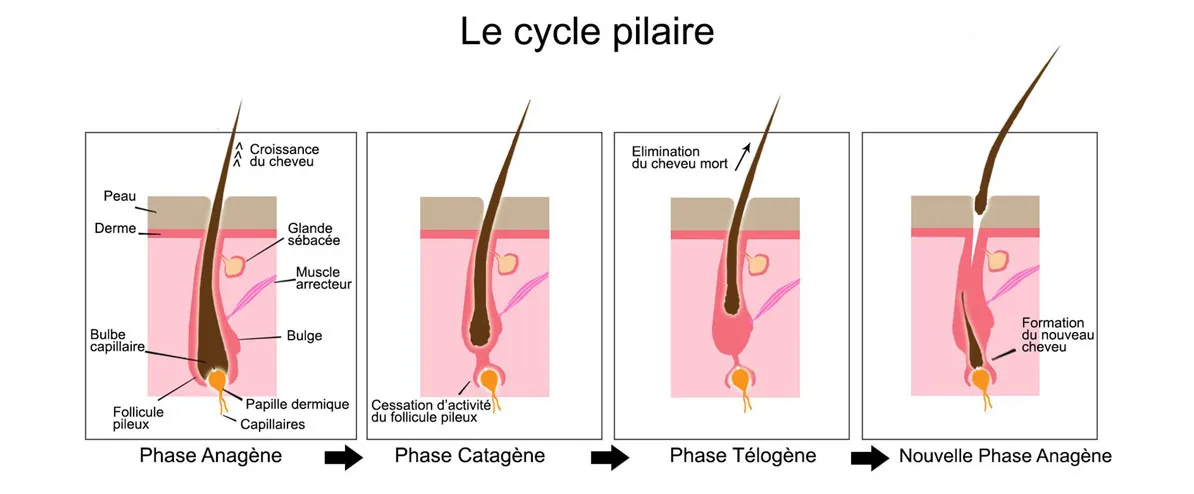
Hair follows a constant cycle of growth, rest and renewal. Hair grows and falls, but because it grows at different rates, it does not all fall at once. The phases of growth, rest, shedding and renewal span a period of 3 years, which means the scalp loses 50 to 200 hairs a day.
When hair loss greatly exceeds that average, it is often pathological. If this problem concerns you, do not hesitate to mention it to Dr Fares Seffen to find out your treatment options.
Androgenetic alopecia
Hair loss in men is set off when a modified form of testosterone, the hormone dihydrotestosterone (DHT), attacks the follicles of the scalp. The hairs produced by the affected follicles gradually reduce in diameter, and in length. Their colour also becomes lighter and they shrink to the point where the hair stops growing.
Not all men are affected by DHT in the same way. Some have genes coded to resist DHT, which means they will enjoy their hair for a long time.
Generally, the follicles at the back and the sides of a man's head are coded to withstand DHT, which is why it is common for men to lose their hair everywhere but in those places.
The areas spared by hair loss are where hair transplant specialists harvest the follicular units intended to cover the thinning areas of the head.
Seek the advice of a specialist
Receive a free personalised diagnosis and an estimated quote prepared by Dr Seffen from your photographs.