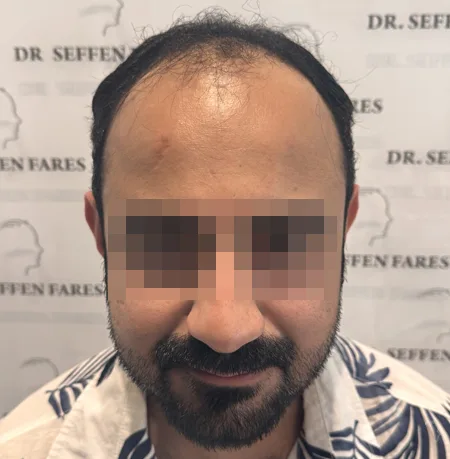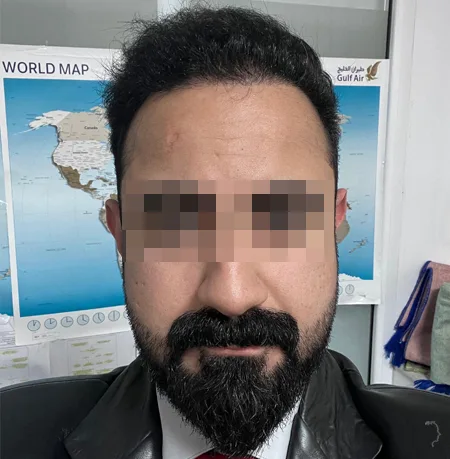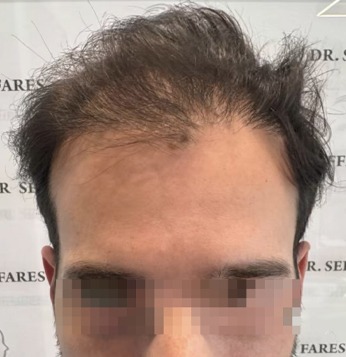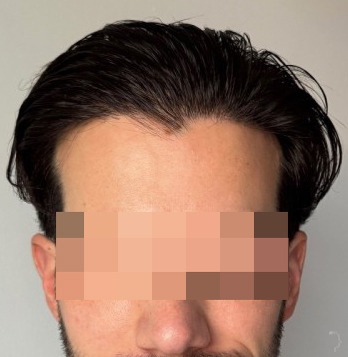
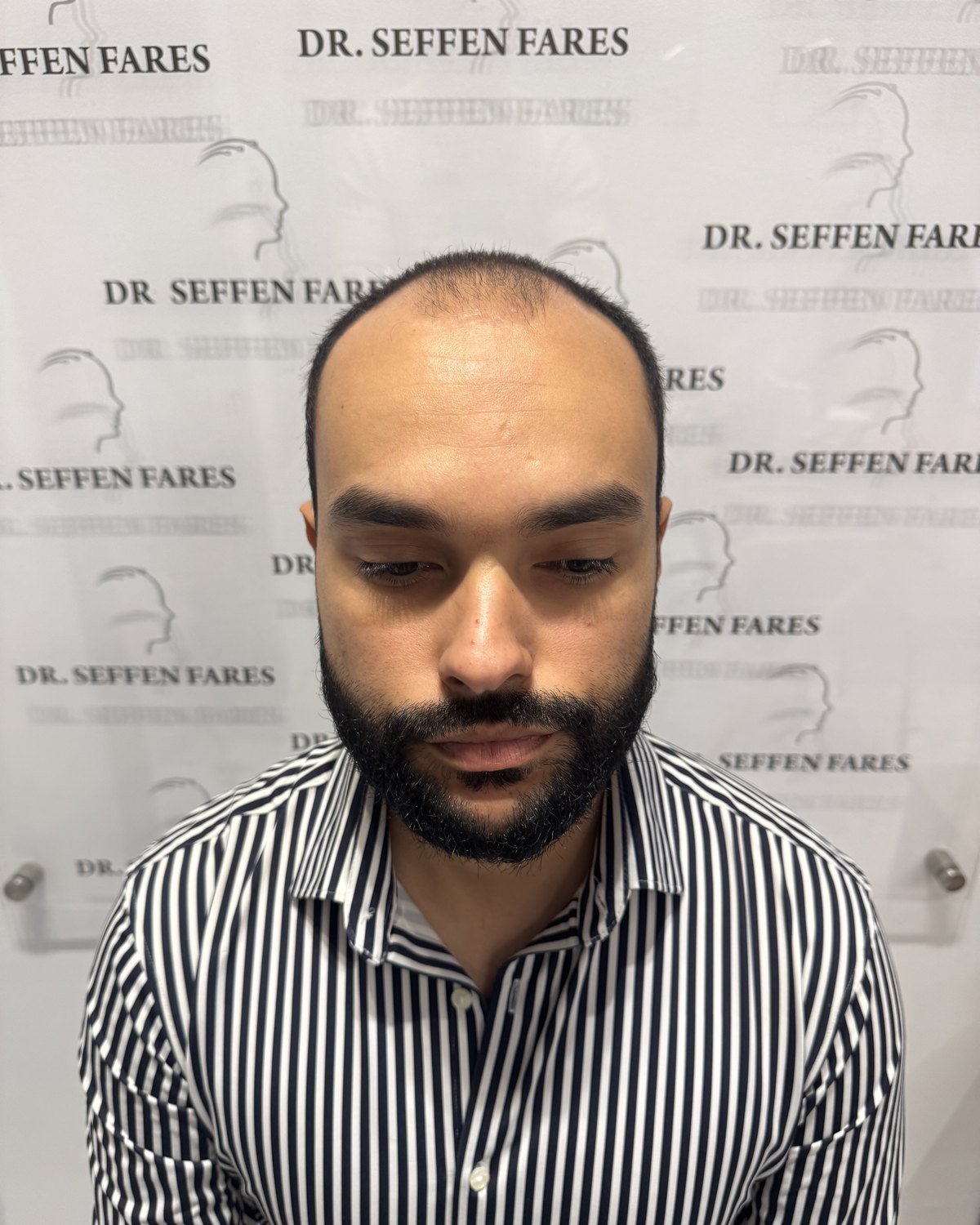
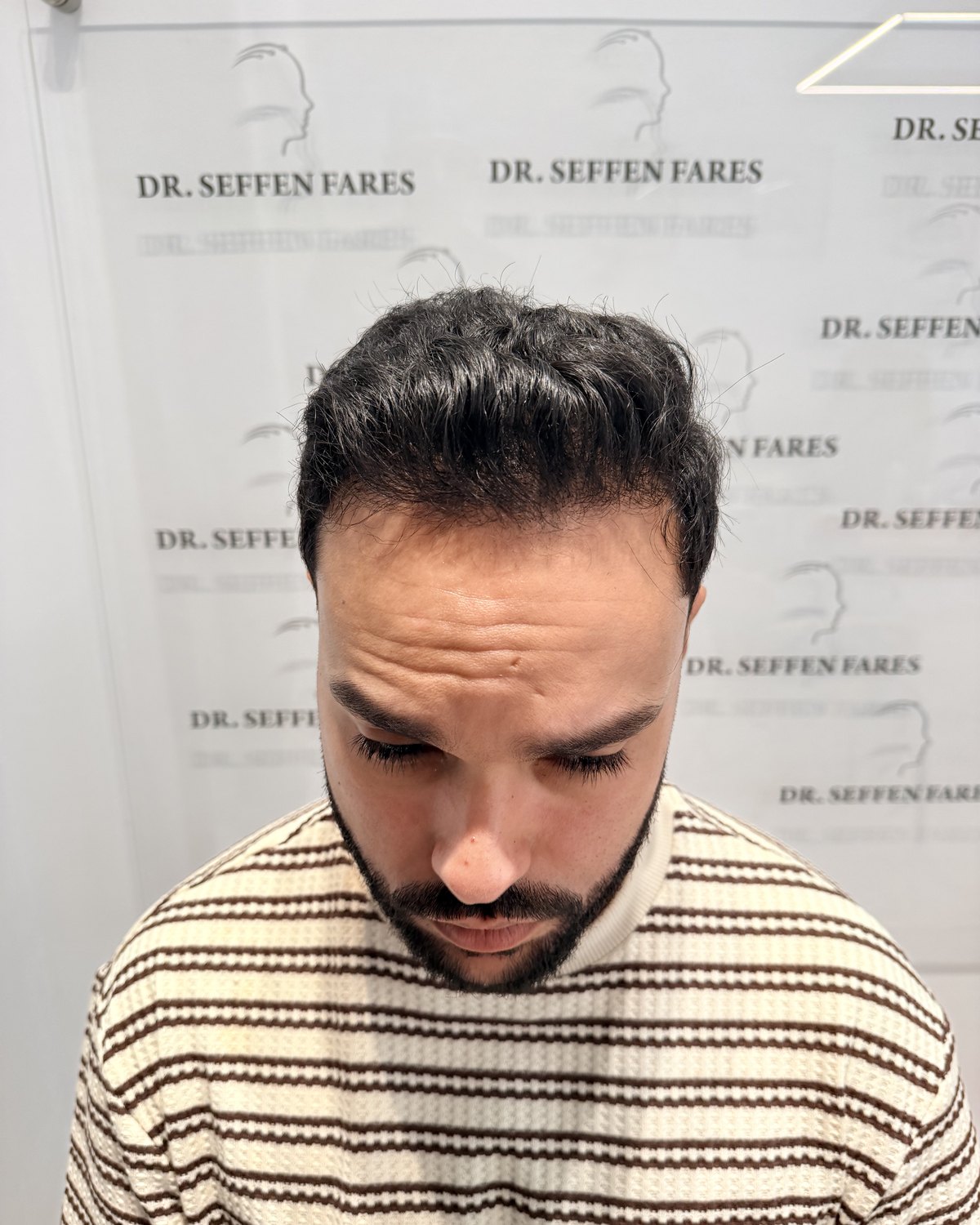
Patient 97View case

The technique
Follicular Unit Extraction, hairs harvested one by one, under local anaesthesia, with no scalpel, no stitches and no linear scar.
The principle
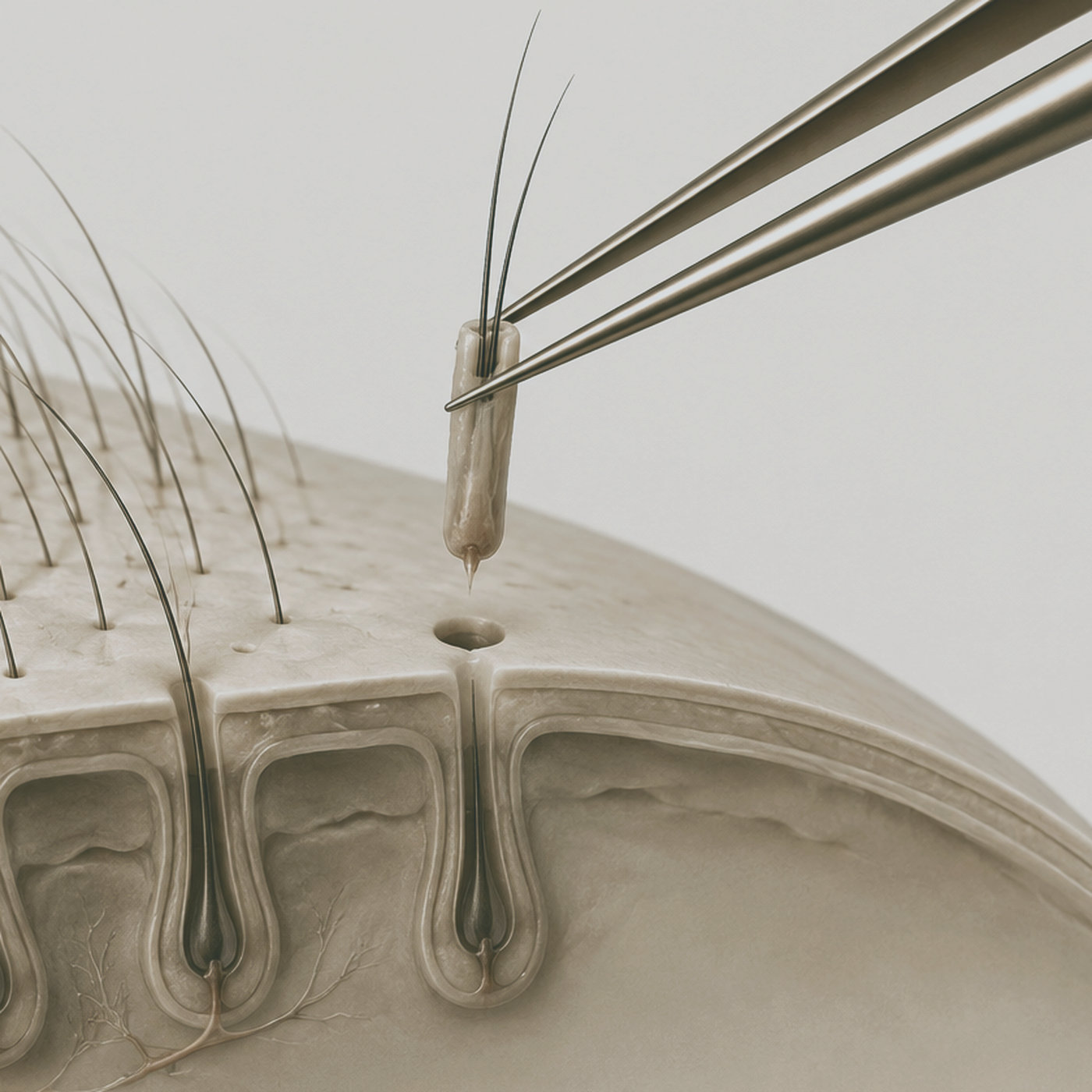
Baldness does not affect the whole scalp. The donor area, at the back and sides of the scalp, is relatively resistant to androgenetic miniaturisation, and hairs taken from it generally keep that resistance once moved elsewhere. The hair you were born with around them, however, can go on thinning: a transplant moves hair, it does not stop hair loss.
Every hair transplant, or hair implant, as it is often called, rests on this principle. FUE means harvesting those hairs one by one, in follicular units of one to four hairs, using a punch under one millimetre, then reimplanting them in the thinning areas while respecting their original angle and direction.
No scalpel, no strip of scalp cut away, no stitches. You go home the same evening.
Our signature
It is the first thing we notice on a face, and the first place a transplant gives itself away. Dr Seffen holds the hairline to a standard that is not negotiable: it must be undetectable, to the point where no one can tell a procedure has taken place. That standard starts long before implantation. Members of his surgical team devote themselves solely to the grafts: they select them, trim them and prepare the single-hair grafts one by one, the ones that give the hairline its natural lightness. The line is then drawn to suit the harmony of the face, which Dr Seffen studied through a university diploma in facial anatomy: it follows each person's proportions, age and features, never a single template.
What can be transplanted
Hair from the donor area can be moved anywhere a hair is missing. Only the fineness of the selected grafts and the angle of implantation change.
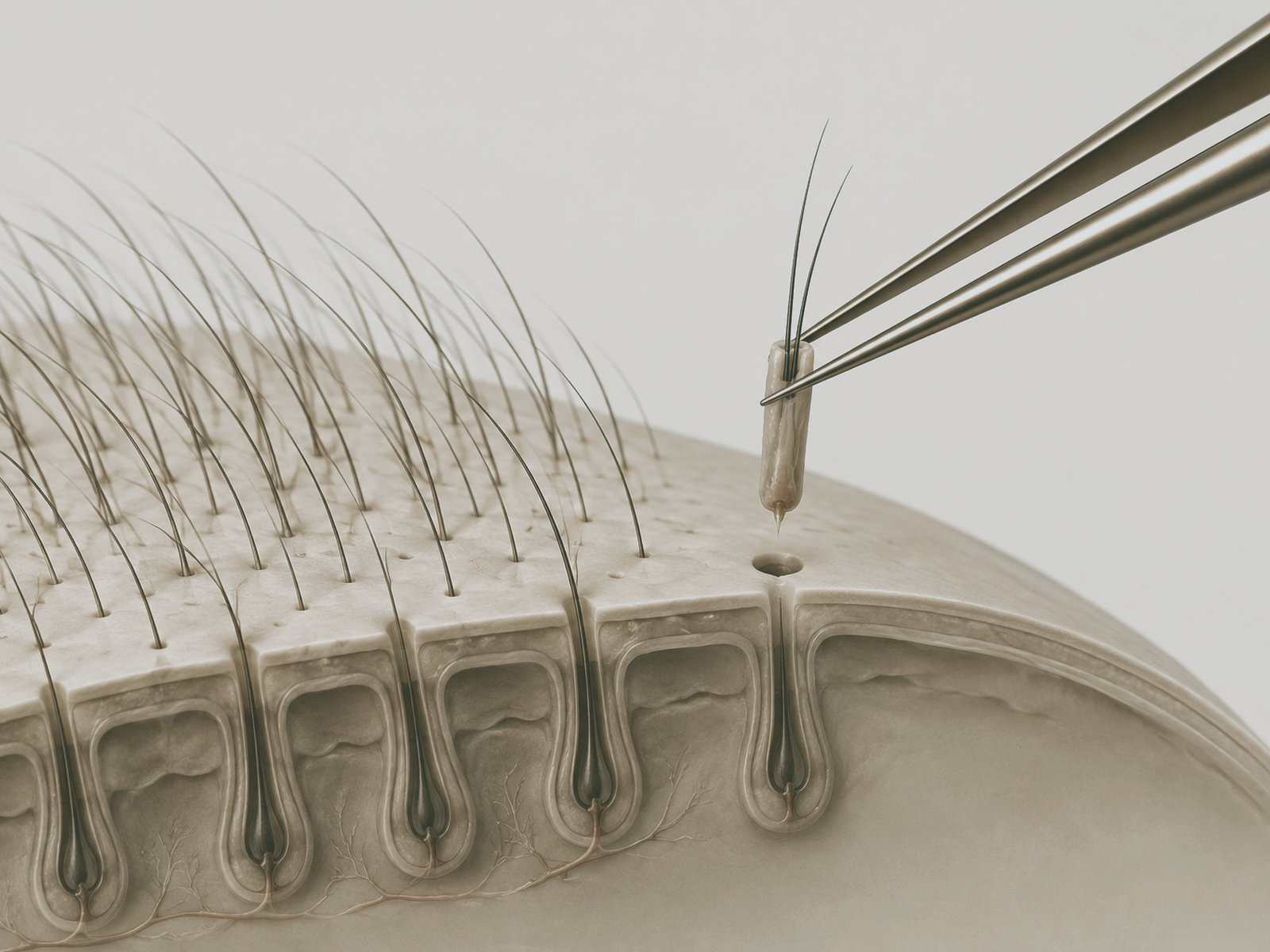
Hairline, temporal recessions, mid-scalp and crown: the most frequent indication, in men as in women.
You are here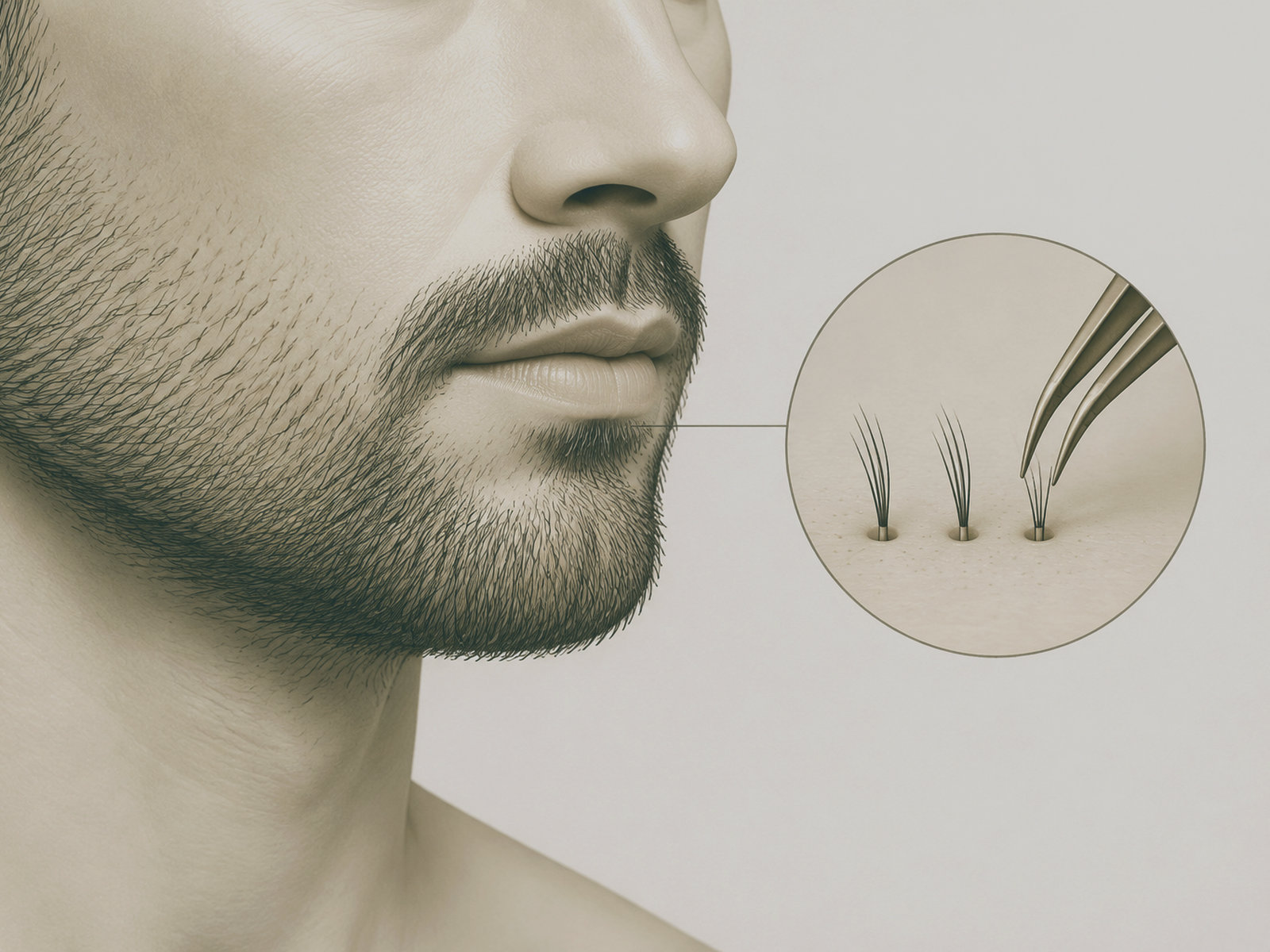
Filling patchy areas, adding density, or fully designing a beard, a moustache or sideburns.
Learn more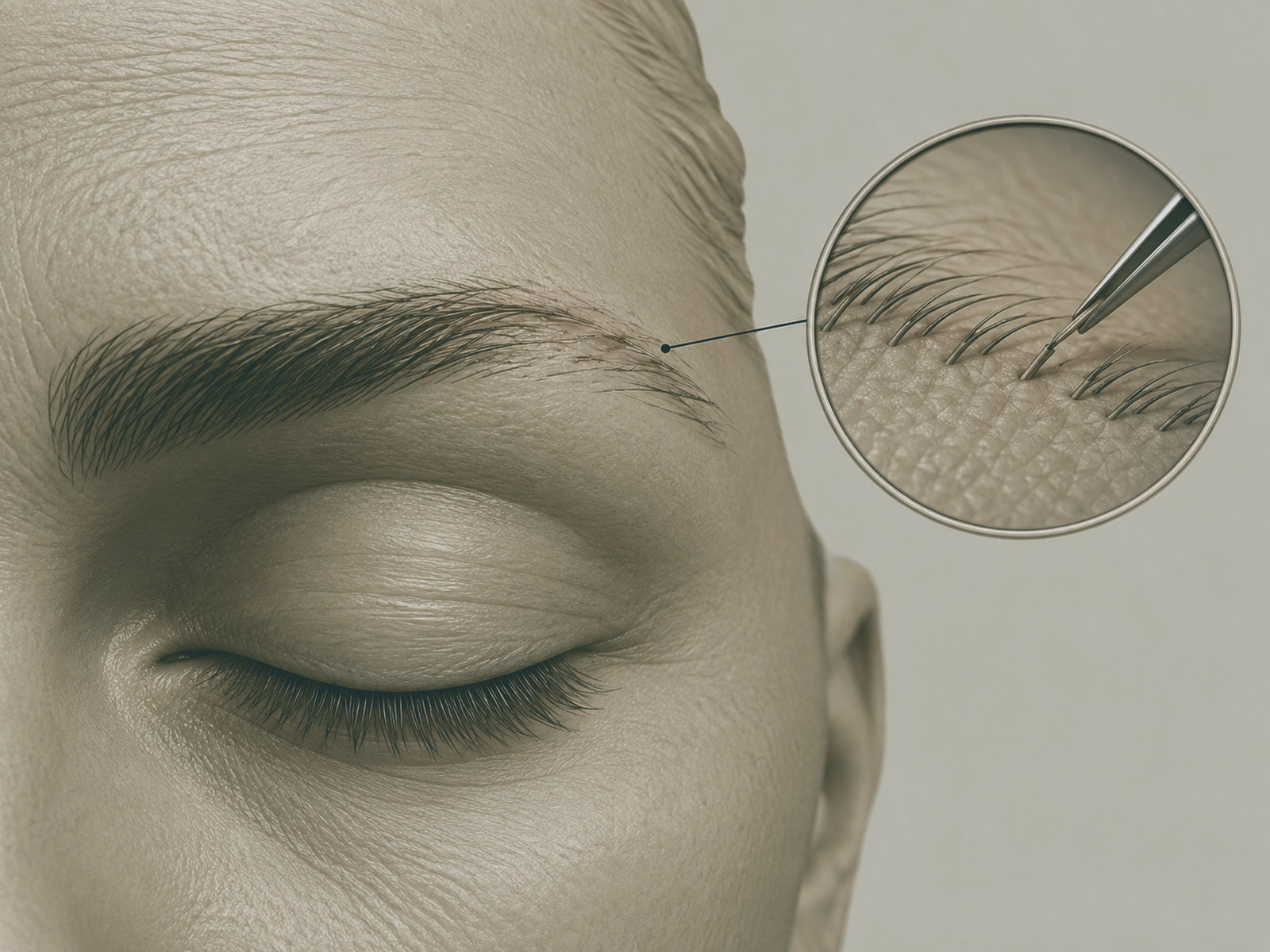
A micro-graft, hair by hair, at a very shallow angle, to restore a brow exhausted by plucking or interrupted by a scar.
Learn more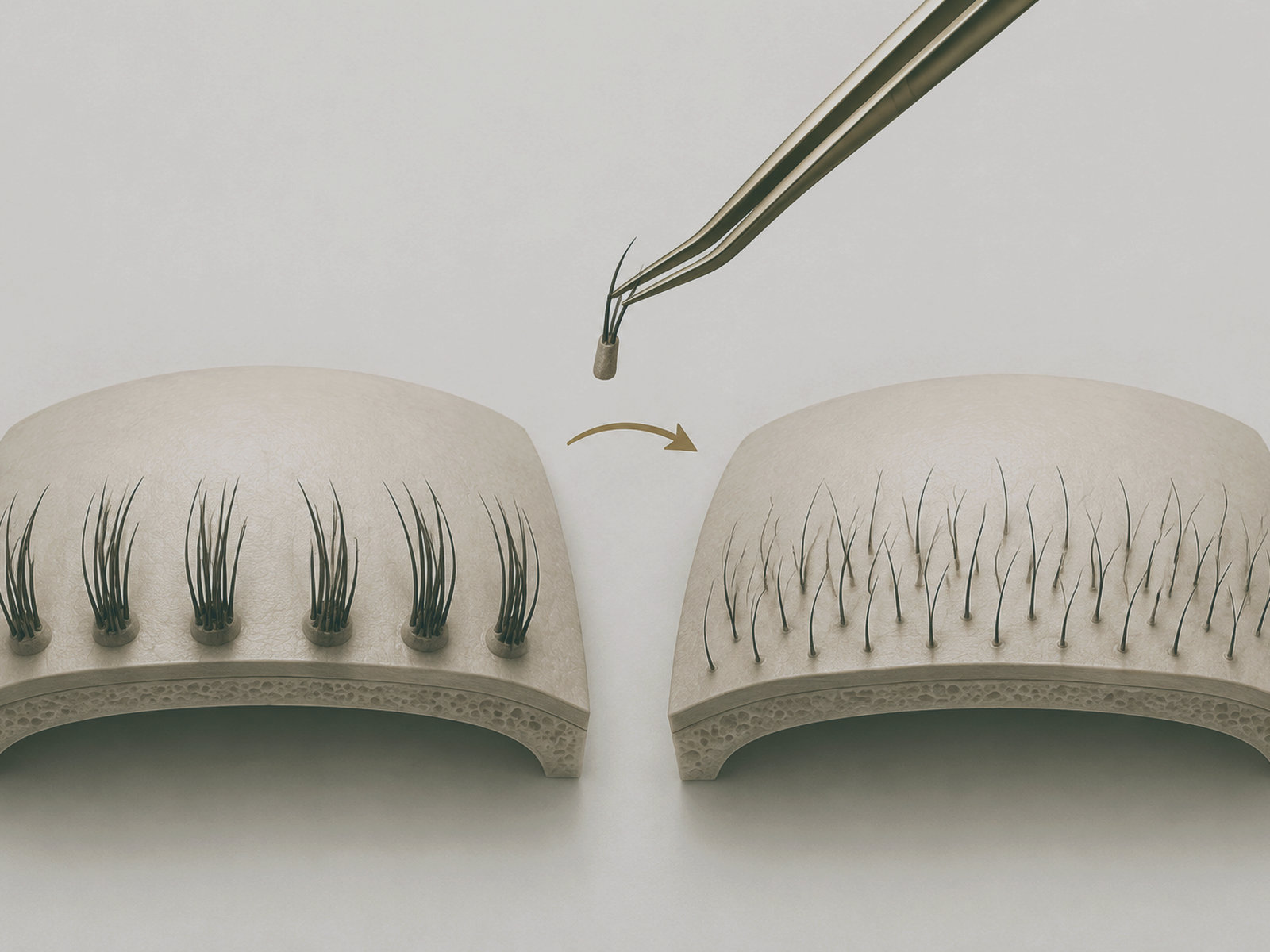
Scarring alopecia after a burn, an accident or surgery, and revision of earlier transplants whose result does not satisfy.
Learn moreIndications
A transplant is not decided on a wish but on an examination: donor area density, hair calibre, stage and above all the speed at which the loss is progressing.
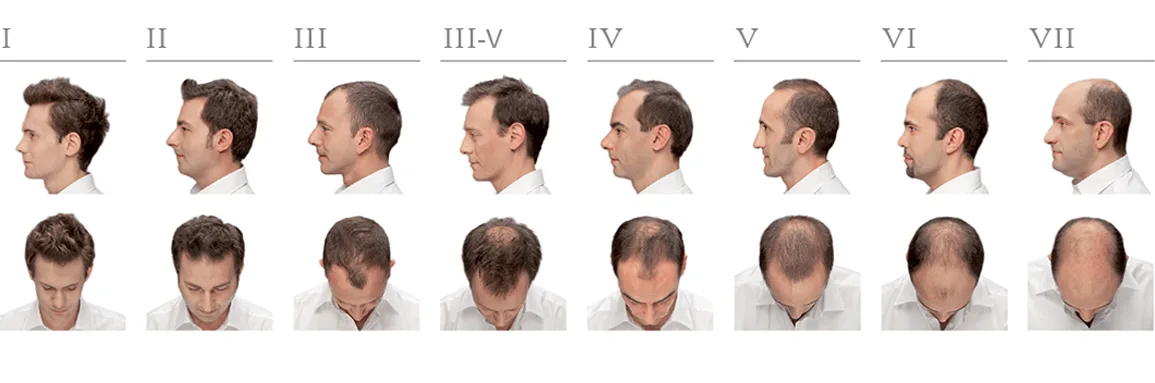
The most frequent indication. Hollowed temples, a receding hairline, a thinning crown. The decision rests on age, the stability of the loss, the donor reserve and what is expected, rather than on a Norwood stage alone.
More diffuse than in men, it often spares the hairline. A transplant is possible if the donor area is itself spared, which calls for careful examination and sometimes hormonal tests.
Without progressive baldness: the aim is then to lower a hairline that sits too high, or to close the temporal recessions, in men as in women.
Burns, accidents, the aftermath of a facelift or neurosurgery, an old strip scar. FUE recolonises the bare area, provided the scar is supple and well vascularised.
A hairline set too low or too straight, grafts too large, a pluggy look, a donor area damaged by excessive harvesting. A demanding exercise, which requires saving an already depleted reserve.
Some situations call for postponing, or declining:
In practice
The procedure takes place at the clinic, as a day case. You arrive in the morning after a light breakfast and leave in the late afternoon. No general anaesthesia, no night in hospital.
Allow six to eight hours, depending on the number of grafts, with a lunch break. Dr Seffen personally performs the design, the anaesthesia, the extraction and the recipient sites, and operates with his full-time surgical assistants under his direct supervision.
Only one procedure is scheduled per day. Your session will not be cut short to free the room for the next patient.
The day itself
Three operative stages: extraction in the morning, then incisions and implantation in the afternoon. The times below are those of an ordinary day; they vary with the number of grafts and the nature of the scalp.
The outline is drawn with a dermographic pencil, standing then seated, and approved by you in front of a mirror. It accounts for the shape of your face, the mobility of your forehead and above all the likely progression of your baldness: a line set too low at 30 becomes a mistake at 50.
The donor area is shaved to one millimetre. Local anaesthetic is injected after a cooling agent is applied: this is the only genuinely unpleasant moment of the day, and it lasts a few minutes.
Each follicular unit is harvested individually with a 0.7 to 0.9 mm punch, manual or motorised depending on skin thickness and hair curvature. Harvesting is spread across the whole donor area so that no thinned patch shows.
Grafts are sorted by hair count: single-hair units go to the hairline, fuller ones behind them to build density. They are kept in chilled solution.
Served on site, in the private rest room.
Recipient sites are created with custom blades, calibrated to the exact diameter of each graft. Angle, direction and depth alone determine how natural the result looks.
Grafts are placed one by one, single units in the front row, deliberately irregular: a perfectly aligned hairline is spotted at a glance.
The donor area is protected, written instructions and prescriptions are handed to you. You return to your hotel.
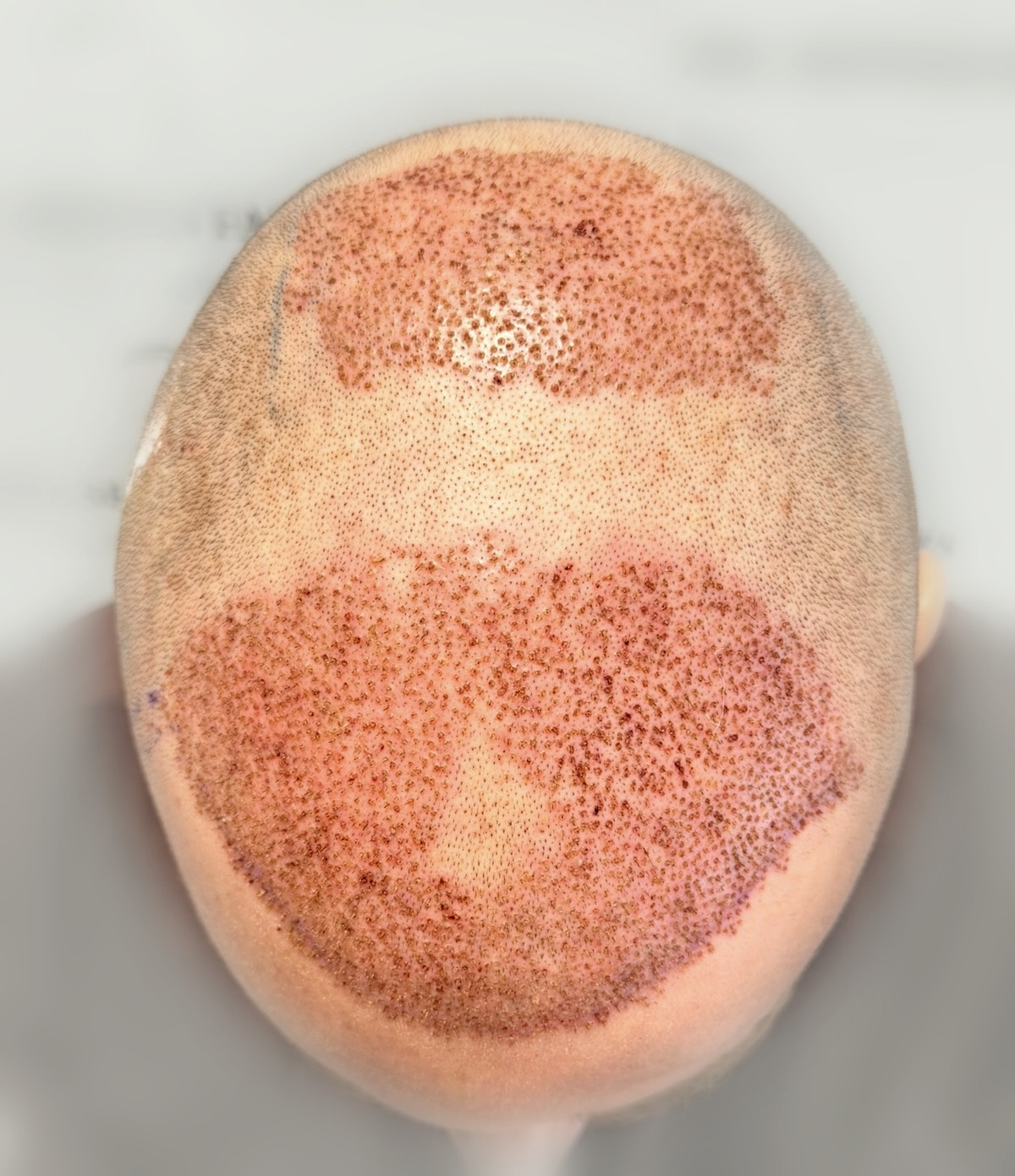
Leaving theatre
This is the image few clinics show. The recipient area is red, dotted, and small crusts form within hours.
Those crusts fall off within ten to fifteen days. The grafted hairs themselves shed almost entirely over the following weeks: this is not a failure, the follicle stays in place beneath the skin and will restart in the third month.
Swelling of the forehead is common between the second and fourth day. It sometimes descends to the eyelids, looks alarming, and resolves on its own.
Comparison
Harvesting hair by hair with a punch. No scalpel, no stitches, no linear scar: it leaves tiny dot scars instead, usually hard to see once the hair has grown back, depending on how short it is worn. Simple recovery, quick return to normal life. In exchange, the procedure takes longer and demands a well-drilled team.
A band of scalp is cut out with a scalpel at the back of the head, then closed with stitches. Hourly yield is higher, and it leaves a linear scar at the back of the head, hidden as long as the hair above it is worn long enough.
FUT remains an accepted technique, and some surgeons favour it for very large sessions. Dr Seffen has chosen to perform FUE only: he prefers not to leave a linear scar on a young patient who may one day want to wear his hair short.
A word of warning
Many clinics attract patients with spectacularly low prices. In almost every case, the price only comes down by cutting what is invisible on the day: the time devoted to each patient, the qualification of whoever actually operates, and the long-term strategy.
The consequences are well known, and they fill revision consultations: hairlines set too low and too straight, grafts too large giving a pluggy look, density poorly distributed, and above all an over-harvested donor area, taken well beyond what is reasonable in order to inflate an advertised graft count. That last damage is the most serious: it is largely irreversible and it mortgages every future procedure.
Repairing then costs more than doing it properly the first time. It often takes two further sessions, sometimes more, with the sole aim of limiting the damage rather than achieving the result hoped for at the outset.
A transplanted hairline is there for life. What is drawn at thirty, you will wear at sixty. See in detail how the cost of a hair transplant in Tunisia is built. Ask the questions: who actually operates, how many patients per day, what follow-up, and above all, ask to see results at twelve months, not photographs taken the day after surgery.
Regrowth
This is the part of the journey patients know least, and the one that causes the most anxiety. Here is exactly what will happen.
They are unpredictable: some patients get neither. When swelling does occur, the forehead swells, sometimes down to the eyelids, and it settles on its own. You sleep with your head raised. No shampoo before the fourth day.
Gentle daily washing following the protocol given to you. The crusts come away gradually. Scratching is strictly forbidden. At day 15 you send us a photograph of the grafted area: it is the first check-up.
Almost all the implanted hairs fall out. The scalp returns to how it looked before, sometimes slightly thinner: this is the expected, temporary telogen effect. The follicles themselves are firmly in place.
The first permanent hairs appear, fine and pale. An uneven look is normal: not all follicles restart together.
About half the hairs have grown back and are starting to thicken. The design of the new hairline becomes legible.
The hairs gain calibre and take on their final colour. It is between the ninth and twelfth month that the result becomes genuinely convincing. The intermediate check-up takes place at ten months.
Full maturation, including the areas implanted last. Final photographic review and assessment: a second session for the crown, continuing medical treatment, or nothing at all.
Afterwards
Sleep on your back, upper body slightly raised, with the travel pillow, and with nothing touching the grafted area.
Shampoo resumes on the fourth day, with the product and technique shown at the clinic: foam applied by hand, never a direct jet, drying by dabbing.
No direct sun exposure in the first weeks, no sea bathing for three weeks and no swimming pool for three months. A cap or hat can be worn from day 15, with no pressure on the grafts; a loose cap may exceptionally be worn from the day after the procedure, for the flight home.
Walking allowed immediately. No sport or physical exertion for two weeks: sweating and blood pressure can compromise graft survival. Steam room and sauna wait two weeks as well, a motorcycle helmet forty-five days.
No alcohol in the two days before the procedure, nor for five days after. Tobacco is avoided for four weeks: it reduces blood supply, and therefore the regrowth rate.
Clippers allowed at one and a half months, on the donor area only. On the grafted area, nothing before three months, and the ends with scissors only. Colouring after three months as well.
Results
Before you travel
Not everyone is, and it is better to know before booking a flight. That is why the process always begins with a photographic file, never with an appointment.
Sometimes the answer is no, or it proposes six months of medical treatment first. That is an honest answer: operating at the wrong moment produces a result that will deteriorate.
Frequently asked
During the procedure, no: local anaesthesia is complete and you feel neither the harvesting nor the implantation. Only the injections at the start are unpleasant, for a few minutes. In the following days, discomfort is mainly in the donor area and a simple painkiller is enough in the vast majority of cases.
Impossible to say without an examination. It depends on the surface to cover, the density you want, the calibre of your hair and the contrast between its colour and your skin. As a guide, closing two temporal recessions often takes 1,200 to 1,800 grafts, a full frontal restoration 2,500 to 3,500. The exact figure is given after analysing your photographs.
This is the most frequent question, and the answer lies entirely in the design and the angle of implantation. A deliberately irregular hairline, built with single-hair units, and incisions that respect the natural orientation give an undetectable result. Transplants that get noticed are those where grafts that are too large were placed in the front row, or where the hairline was drawn too low and too straight.
In most patients it lasts. Grafted hairs come from the donor area at the back and sides of the scalp, relatively resistant to androgenetic miniaturisation, and they generally keep that property once moved. The surrounding native hairs, however, may continue to fall: that is why the operative plan anticipates the progression of baldness, and why medical treatment is often proposed alongside.
Sometimes. Where baldness is extensive, the anterior two thirds, which frame the face, are treated first, and the crown in a second session after fifteen months. This strategy preserves the donor reserve rather than exhausting it at once.
A cap or hat can be worn from day 15, with no pressure on the grafts; a loose cap may exceptionally be worn from the day after the procedure, for the flight home. Nothing tight, and nothing that rubs the grafted area.
Three or four nights are enough: arrival the day before, the procedure over one or two days, then a check-up and the first wash the next day, before you leave. Follow-up then continues remotely, by photographs or video consultation, until the final review at fifteen months.
The package
Always ask for this list in writing, whatever clinic you are considering. A low package price is usually explained by what it leaves out.
One patient a day, with Dr Seffen in theatre from start to finish
The pre-operative consultation and the drawing of your line
Local anaesthesia and all single-use instruments
Airport, hotel and return transfers
Lunch and a private rest room on the day
The first wash and the next-day check at the clinic
Follow-up by message and photographs throughout
The final review at fifteen months, included
Send your photographs and receive a preliminary assessment and an estimated quote, prepared by Dr Seffen himself. Free, and without obligation.