Contact Dr Seffen Fares — Phone / WhatsApp: (+216) 55 203 302
Follow our results:Follow us on Instagram

In practice

Restorative and reconstructive hair transplant

Treating scarring alopecia following a burn, an accident, surgery or a previous poorly performed transplant.

Head injuries can affect the scalp, eyebrows and beard and destroy the follicles located there. Injured areas may therefore be devoid of hair after healing: this is a stable, secondary scarring alopecia. It is not the same thing as an inflammatory scarring disease that is still active, which is a contraindication and is covered further down.

One case, in three stages

A graft on scar tissue cannot be judged from a single photograph. Here are the initial state, the pre-operative plan and the result, in the same patient.

Burned at seven, over eighty per cent of the scalp

Third-degree burn at the age of seven, over eighty per cent of the scalp. A teenager at the time of treatment. Three procedures, eight months apart, for a total of 5,200 grafts. A low dose of oral minoxidil was maintained throughout, for the vascularisation of the scar tissue.

Before
BeforeScar tissue covers the hairline and the midscalp. The follicles there were destroyed: nothing grows back on its own.
The plan
The planThe pre-operative drawing, in marker, before the second procedure. The grafts already implanted can be seen as dark stippling against the areas of scarring.
After
AfterAfter the three procedures. Hair grows through the scar, and there is a hairline again.

Patient of the clinic. Photographs cropped above the eyebrow line.

Cases treated

Scarring alopecia: the most frequent origins

Every scar is different. The pre-operative examination determines feasibility, achievable density and the number of sessions required.

Thermal burns

Direct exposure to fire or contact with hot substances.

  • Flames and explosions
  • Metal, water or boiling liquids
  • Deep and extensive scalp scarring

Chemical and radiation burns

Caused by exposure of the skin to corrosive substances or to radiation.

  • Acids and cleaning solutions
  • X-ray or gamma radiation
  • Sequelae of radiotherapy

Accidents and trauma

Among the most common injuries affecting the scalp and facial hair.

  • Car accidents: crumpled metal, car window glass
  • Sports injuries and industrial accidents
  • Physical violence
  • Childhood injuries whose scars remain for life

Surgical sequelae

Surgery, especially neurosurgery, may require access through the skull, which can damage hair follicles and leave scars.

  • Neurosurgical approaches
  • Linear scar from a previous FUT
  • Donor areas damaged by a previous transplant

Traction alopecia

Caused by repeated mechanical tension on the roots.

  • Straightening, African braids, perms
  • Ponytails that are too tight
  • Repeated plucking of the eyebrows

Contraindications

Chronic inflammatory diseases of the scalp can cause scarring alopecia. It is not advisable to perform a hair transplant while such a condition is active.

  • Lupus erythematosus
  • Localised scleroderma
  • Lichen planus

Hair reconstruction: is it a viable option for scarred hair-bearing areas?

When a burn, trauma or operation destroys the hair follicles of a given area, hair does not grow back there. When a scar on the head is small, it is sometimes possible to conceal it by styling the hair accordingly. However, the size and location of some scars can make them impossible to hide.

In the majority of cases, FUE hair transplantation is an effective option for treating scarred and thinning hair-bearing areas following an accident. A thorough examination of the area, and of the factors bearing on feasibility, is what makes very good results possible.

What you should know

The chances of success are lower

On a healthy scalp, a graft correctly harvested and placed grows in nine cases out of ten. That is the usual figure for an ordinary transplant, and the one everybody quotes.

On a scar it no longer holds. Published series put regrowth at six to eight grafts out of ten depending on the nature of the scar, and lower still on deep burns, where the skin has the poorest blood supply. A clinic quoting you the same odds as on a normal scalp is not telling the truth.

The reason is simple: a graft is living tissue that has to be fed within hours of being placed. A scar is collagen where a network of vessels used to be. Less blood means fewer grafts taking.

None of this means surgery should not be done. It means the objective changes. We are not trying to restore normal density: we are trying to make the scar stop showing. That is an achievable objective, and often achieved, provided it is stated for what it is.

The examination

The factors that determine feasibility

All are assessed before surgery, and it is their combination that decides, never one of them alone.

Blood supply to the area

This is the factor that weighs most. Follicles need a blood supply to survive transplantation, and the injury may have destroyed that network. We judge the colour of the skin, its warmth, and how it bleeds to a test prick.

Thickness and suppleness of the skin

A hypertrophic scar, thick and hard, holds grafts away from the vessels that must feed them. An atrophic scar, too thin, does not house them properly. Between the two, skin that has become supple again is the best sign.

Maturity of the scar

A scar keeps changing for about a year: it contracts, changes colour, softens. Operating before that maturation means placing grafts in ground that is still going to move. Waiting is part of the treatment.

The state of the donor area

A repair after a failed transplant often comes with a donor area already depleted. The capital available then dictates how much surface it is reasonable to cover, and sometimes means treating the most visible area first.

Smoking

It narrows the vessels, precisely where they are already lacking. On an ordinary transplant its effect stays modest; on a scar it can be the difference between good take and failure. Stopping is asked for before and after surgery.

Active inflammatory disease

Lupus erythematosus, localised scleroderma, lichen planus. While the disease is active a transplant is contraindicated: the grafts would be destroyed like the original follicles, and surgery can reactivate the disease.

The method

How we work around these limits

A test session before the full one

On a scar whose blood supply is in doubt, a few dozen grafts are placed first and judged at three or four months. What is observed then is worth more than any prediction: if take is good, the full procedure goes ahead with confidence; if it is poor, the capital has not been spent for nothing.

Deliberately moderate density

Placing grafts tightly in poorly supplied skin means making them compete for blood that is already short, and losing them all. So we implant less densely than elsewhere. The eye does not count hairs: partial, well-distributed coverage is enough to make a scar disappear.

Two sessions rather than one

The second session, a year after the first, thickens what has taken and fills what is missing. It also benefits from improved ground: the grafts of the first session brought some blood supply with them.

What a transplant does not do

It does not remove the scar. The skin stays what it is, with its colour and its relief. It is the hair that covers it. On a wide, markedly raised scar, a plastic surgery procedure may have to come first.

Results

Reconstruction and correction cases

Including revisions of earlier transplants and badly depleted donor areas.

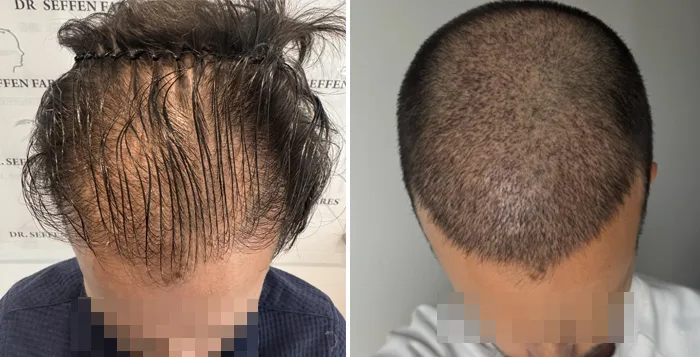
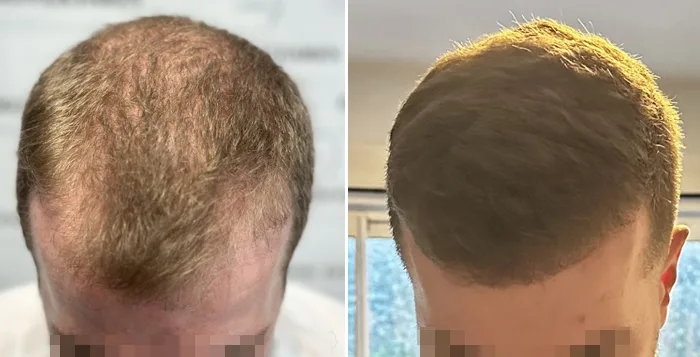
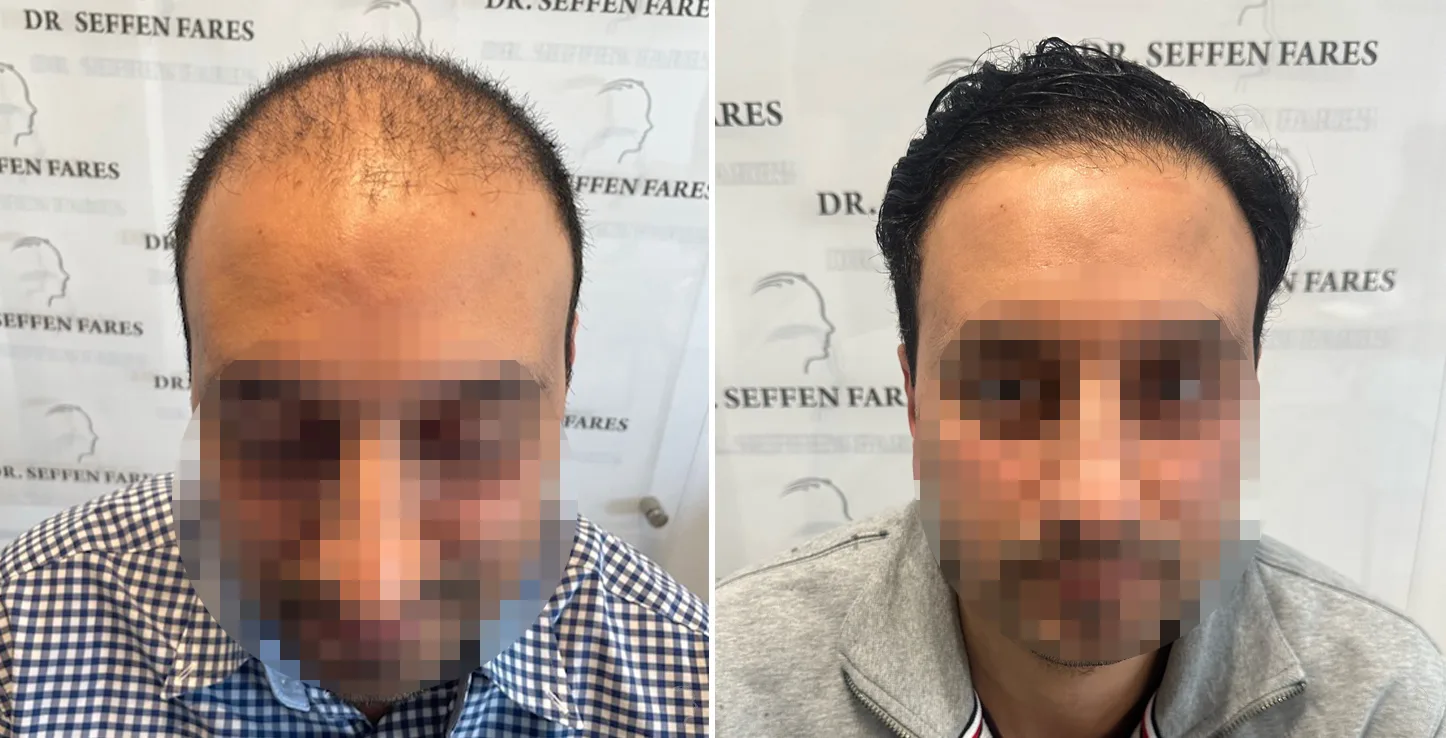
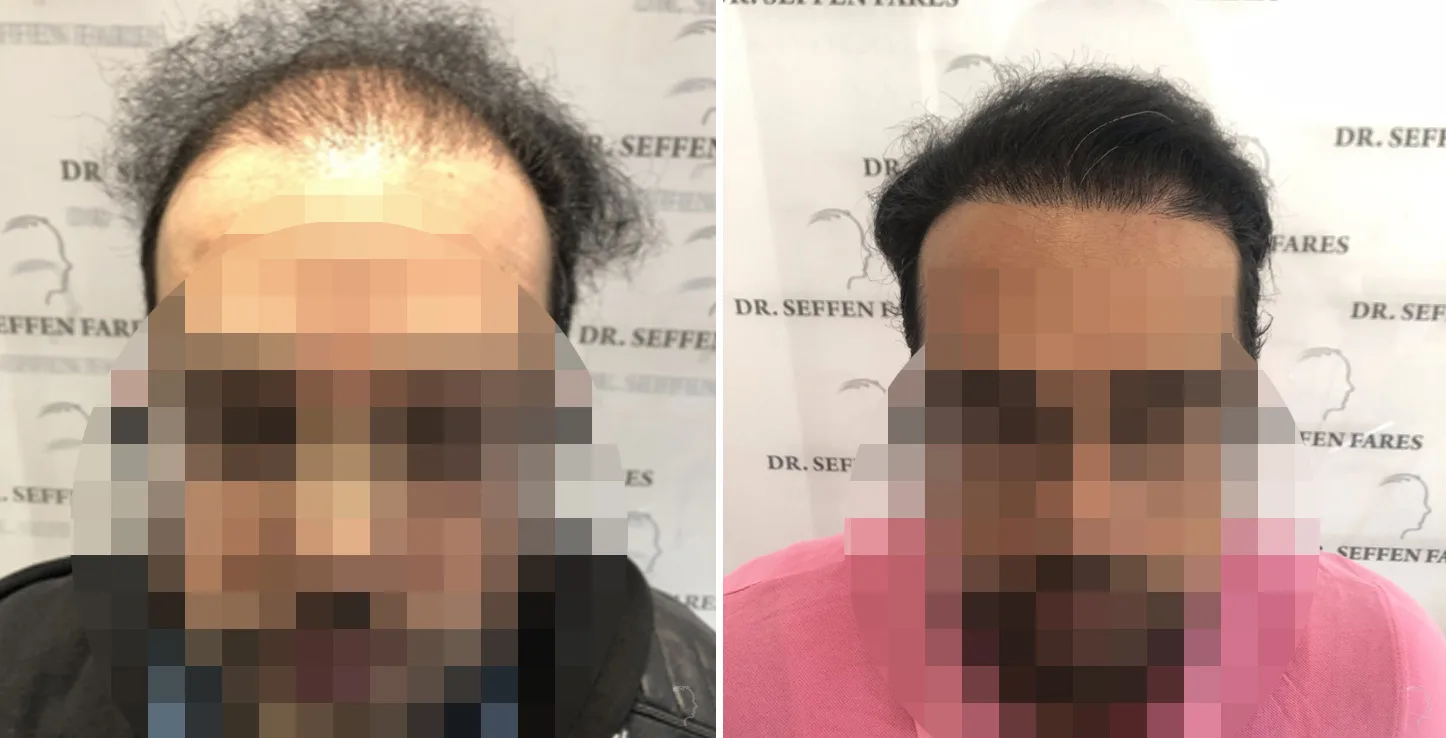
Before and after combined in a single image.

Have your case assessed

Send your photographs and receive a preliminary assessment and an estimated quote, prepared by Dr Seffen himself. Free, and without obligation.