

September 6, 2026
Scalp microneedling: the cheapest technique, and the worst performed
A micro-needle roller, a few minutes a week. It is the only complement to minoxidil whose effect has been measured in a comparative trial, and it is also the one most often done badly.
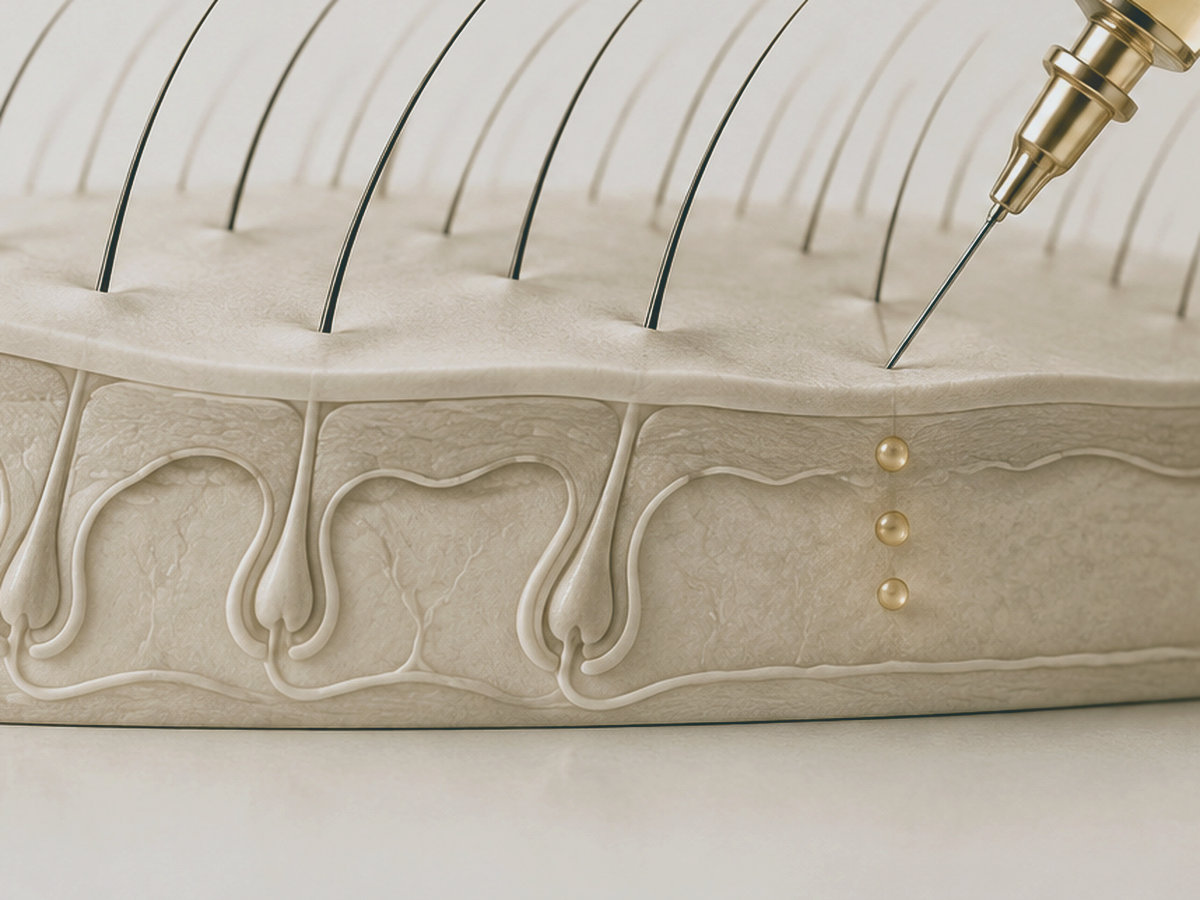
Microneedling means creating, with micro-needles, thousands of tiny perforations in the scalp. The skin answers these micro-injuries with a repair cascade: growth factors, blood flow, activation of the follicle's stem cells. It is that response, and not the perforations themselves, that is of interest.
It has a rare distinction in this field: it is one of the only complementary techniques whose effect has been measured against a comparator, rather than simply observed.
What the reference trial shows
An often-cited trial compared, in men with androgenetic alopecia, minoxidil alone against minoxidil combined with weekly microneedling. The combined group achieved a clearly greater gain in density, and a far higher proportion of patients reporting improvement.
The correct reading of that result is this: microneedling is not a treatment, it is an amplifier. It has not been shown to work on its own. It improves what minoxidil does, most likely by increasing its penetration and by adding its own repair response.
Why it is so often done badly
Because it is sold everywhere and explained nowhere. Four mistakes come up again and again.
Needles that are too long. Beyond 1.5 mm nothing is gained and dermal scarring becomes a risk. The protocols that have been studied use modest lengths.
Too high a frequency. The scalp must be given time to repair. One session a week is the frequency used in the published work; more often than that, inflammation is sustained instead of being allowed to run its course.
Minoxidil applied straight afterwards. This is the most common and the most unpleasant mistake. On perforated skin, the alcohol and propylene glycol in minoxidil solutions cause burning and prolonged irritation. You have to wait, a day in most protocols.
Non-sterile or reused equipment. A roller blunts and becomes contaminated. Blunt needles tear instead of piercing.
After a transplant
The question comes up at every follow-up consultation. The answer is clear: no microneedling on a grafted area for several months, and never without the advice of the surgeon who operated. Grafts take months to anchor, and a one-millimetre needle easily reaches the depth at which they sit.
On the donor area the question does not arise in the same terms, but the healing time still has to be respected.
What to take from this
It is the least expensive complement and one of the best documented. It replaces no treatment, it increases the effect of one. And as so often in hair medicine, what decides the result is not the technique but the regularity: one session a week for six months is worth more than three enthusiastic sessions and then nothing.
Seek the advice of a specialist
Receive a free personalised diagnosis and an estimated quote prepared by Dr Seffen from your photographs.