

September 8, 2026
Hair mesotherapy: what it does, and what it does not
Micro-injections of vitamins and trace elements into the scalp, session after session. A widespread technique whose limits are worth knowing before you commit to it.
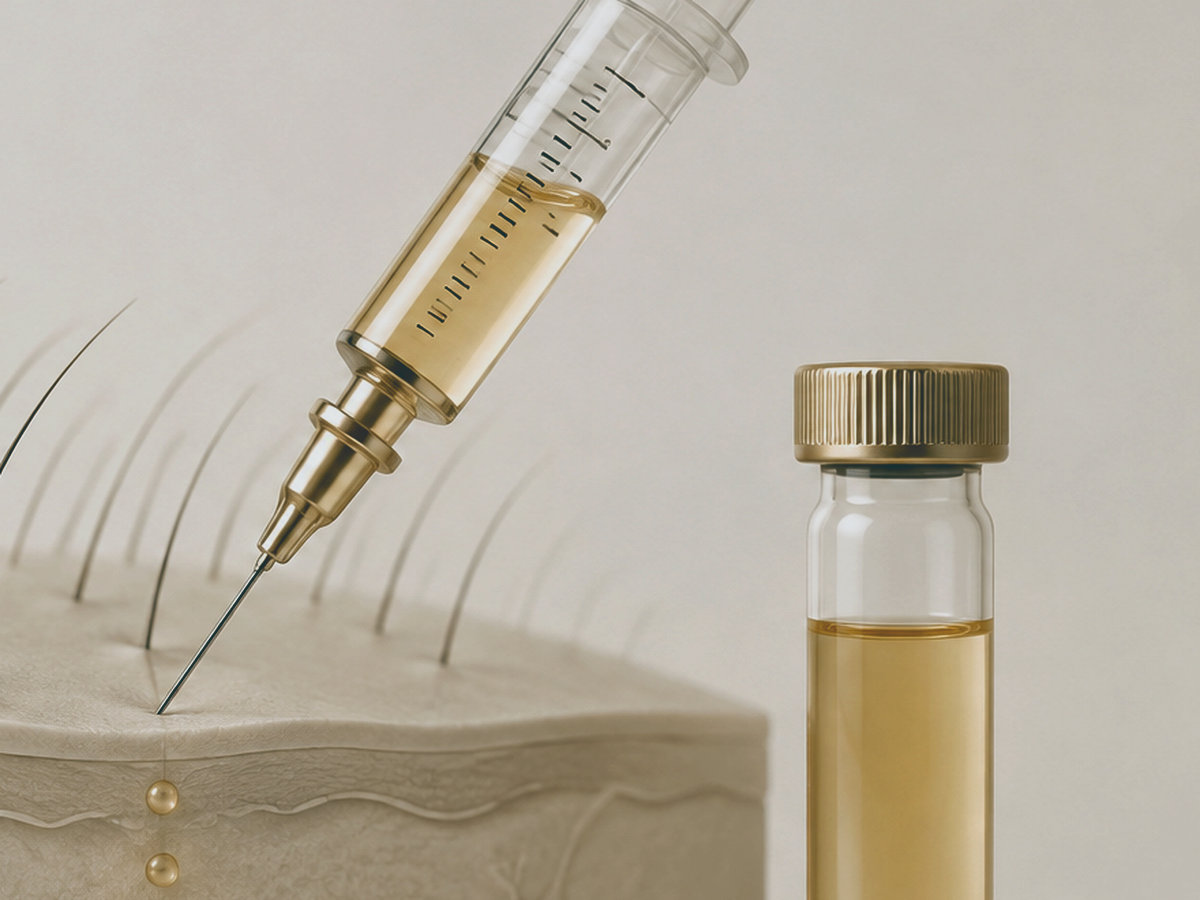
Hair mesotherapy consists of injecting, very superficially and at many points, a mixture of vitamins, trace elements, amino acids and sometimes hyaluronic acid. The injections are given with a fine needle or a gun, into the scalp, in sessions two to four weeks apart.
The idea is old and simple: to bring substances into direct contact with the follicle which, taken by mouth, would be diluted throughout the body. The question is not whether the injection reaches its target, it does. The question is what the follicle does with it.
What you can expect from it
Patients most often report three things: hair loss that slows, hair that looks less fine, and a more comfortable scalp. These effects are real, but they concern the condition of existing hair, not the regrowth of hair that has gone.
That is the distinction that matters, and the one least often explained in consultation. Mesotherapy does not bring a dead follicle back. It can improve the quality of what is still growing. In early hair loss that is sometimes enough to stabilise a situation. In established baldness it replaces neither medical treatment nor a transplant.
What the literature says
We should be honest on this point: the level of evidence for hair mesotherapy is low. Formulations vary from one practice to another, so do the protocols, and the published studies are small and often without a control group. There is no mesotherapy equivalent of the trials that led to the approval of minoxidil.
That does not mean it is useless. It means no measured result can be promised, and that a practitioner who quotes you a regrowth percentage is going beyond what is known.
Our position
The clinic has used mesotherapy and evaluated it, as it has other approaches. Given this level of evidence, it now favours the treatments whose efficacy is best established: finasteride and minoxidil against miniaturisation and for regrowth, and PRP, mainly after a transplant, to support healing and the recovery of the scalp.
What to know before starting
The sessions are barely painful but unpleasant, and several are needed: four to six for a first course, then maintenance. The effects fade once treatment stops, as with any maintenance treatment for hair.
There is no social downtime: redness and small papules disappear within hours. The contraindications are those of any injection: anticoagulant treatment, scalp infection, pregnancy.
One last point, which holds for the whole of aesthetic hair medicine: ask for the exact composition of what is being injected into you. A practitioner who cannot give it to you should not be injecting it.
Seek the advice of a specialist
Receive a free personalised diagnosis and an estimated quote prepared by Dr Seffen from your photographs.