

June 29, 2019
The characteristics of hair loss in women
Age of onset, speed of progression and pattern: three ways in which androgenetic alopecia differs between women and men, and what follows from them for everyday hair care.
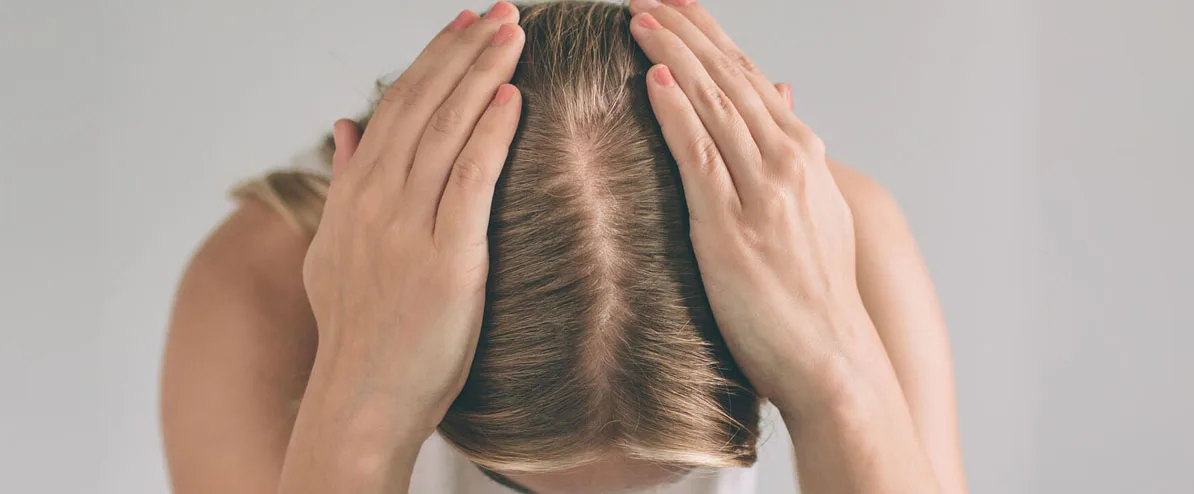
Hair loss is multifactorial and poorly understood. The most common hair loss in women is androgenetic alopecia. This condition is characterised by the gradual replacement of the terminal follicles of the frontal region and the vertex by miniaturised follicles, which leads to a visible reduction in hair density.
Androgenetic alopecia in women is more common in post-menopausal women than in younger women. Hair loss can follow a different pattern from one person to another. Some notice an overall thinning of their hair, while others see the same problem confined to specific regions of the head.
Although a family history of hair loss is a significant risk factor, it is worth remembering that androgenetic alopecia is not the only type of hair loss, and that gene expression is not the only factor that can bring the condition on.
The characteristics of hair loss in women
Differences between alopecia in men and in women
Although alopecia can affect both men and women, its characteristics differ noticeably between the sexes. Here are several examples.
Age of onset
By their mid-fifties, most men show some degree of hair loss. In women it is rather towards the end of their sixties that marked hair loss can be seen; it should be noted, however, that 40% of women are also affected by hair loss or thinning.
Speed of progression
Alopecia progresses over a longer period in women; in men, hair loss is generally far faster and more obvious.
Pattern of progression
Men are often affected by hair loss at the temples or along the frontal hairline. This hair loss can gradually develop into balding.
In women, it is a thinning of the hair across the whole scalp that progresses. Hair loss also sometimes occurs in specific places, such as the central parting or the strands at the forehead. This shows how important it is to treat hair gently, to avoid pulling too hard on the follicles (the traction exerted by very tight hairstyles can cause hair loss, for example), to do without the hairdryer from time to time, and to avoid using aggressive chemical products (dyes, perms, and so on) too often.
Seek the advice of a specialist
Receive a free personalised diagnosis and an estimated quote prepared by Dr Seffen from your photographs.